Tests, technology and the business of care
How to Become a Radiologic Tech, Sonographer or MRI Tech
Take the X-rays, CT and MRI scans and ultrasounds that doctors use to find what is wrong inside the body.
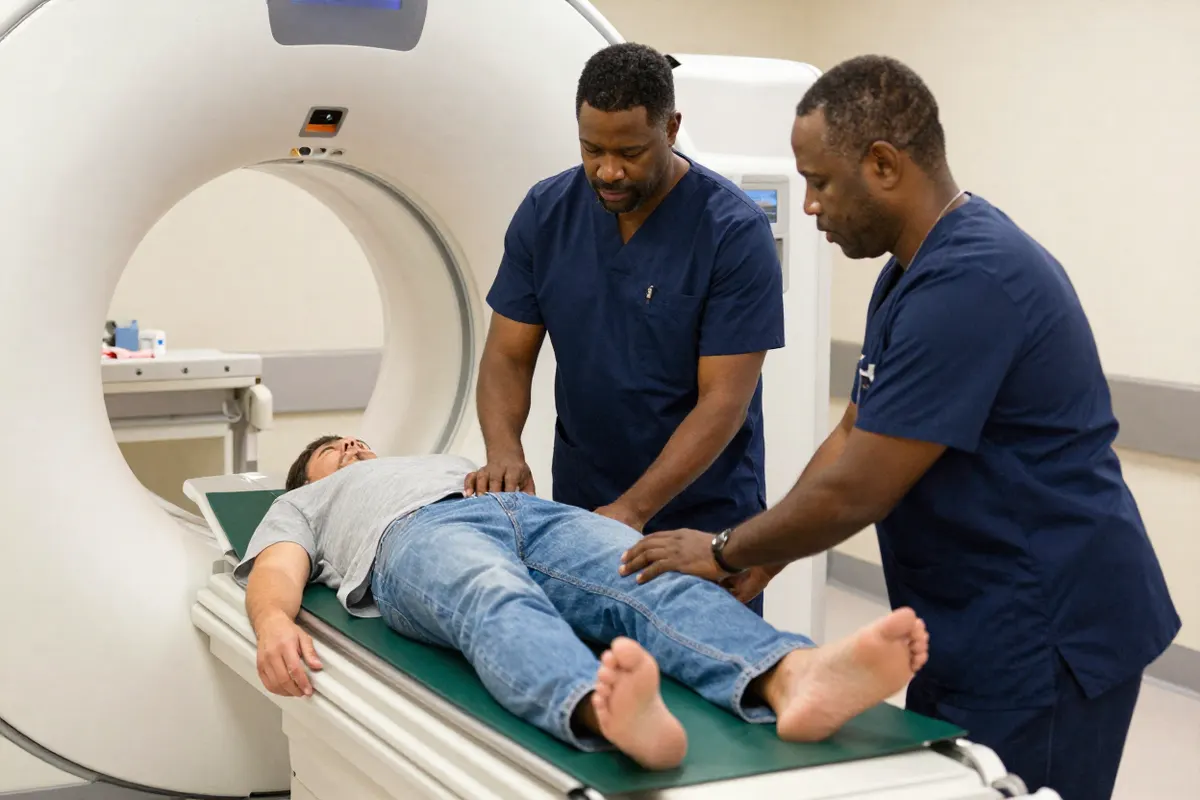
What the job is
Imaging techs make the pictures that show what is happening inside the body. Radiologic technologists take X-rays and often move on to CT, mammography or interventional work, MRI technologists use magnets and radio waves instead of radiation, and sonographers use ultrasound to image organs, babies, hearts and blood vessels. Related roles include nuclear medicine technologists, cath lab techs and radiation therapists, who treat cancer rather than diagnose it. Most of these jobs take a two-year degree and a national registry exam, and many states also license the people who use X-ray equipment.
A typical shift
- Check each patient's identity, the order and any reasons the exam is unsafe, such as pregnancy, implants or a contrast allergy
- Position patients precisely, sometimes in pain or unconscious, and set the technique on the X-ray, CT, MRI or ultrasound machine
- Shield patients and yourself from radiation, or screen everyone entering the MRI room for metal
- Scan, review every image for quality and repeat views before the radiologist reads them
- Start IVs and give contrast where your role allows it, then watch the patient for a reaction
- Cover the emergency department, operating rooms and portable exams at the bedside, often on evenings, nights or call
What a shift looks like
A trauma CT
A car crash patient arrives in the emergency department on a backboard. The CT tech moves him onto the table with the team, keeps his neck in line, scans head to pelvis in minutes and flags the images so the radiologist can read them while the surgeons wait.
A first-trimester ultrasound
A sonographer scans an anxious patient at eight weeks. She measures the pregnancy and records the heartbeat, but she does not give a diagnosis: she captures complete images and leaves the results conversation to the physician.
The MRI screening catch
Before an outpatient brain MRI, the technologist walks through the safety questionnaire again and the patient mentions shrapnel from military service. The tech stops, calls the radiologist and the scan is changed to CT instead.
Who does well in this job
Imaging suits people who like technology and anatomy, enjoy getting a precise result with their hands and a machine, and want patient contact in short, focused encounters rather than long bedside shifts. You need physical stamina for lifting and positioning, calm under pressure in trauma and surgery, and the patience to explain an exam to a frightened patient. Many techs come straight from a community college program, while others switch in from medical assisting, nursing assistant work, the military or another career.
You will likely enjoy it if
- You like working with equipment and getting the settings exactly right
- You can stay calm in the emergency department or operating room
- You are comfortable lifting, turning and positioning patients all shift
- You want a skilled healthcare job in about two years, not four or more
What you need
- An accredited imaging program, usually an associate degree; ARRT certification also requires an associate degree or higher
- A national registry exam such as ARRT (radiography, MRI, CT and others) or ARDMS (sonography)
- A state license or certificate in states that require one, plus CPR or Basic Life Support for many employers
- A background check, an ethics review where needed and the immunizations hospitals require
Skills that help
Your path into the job
- 1Choose your first modality: radiography is the most common start and opens CT, MRI and mammography later, while sonography is a separate track
- 2Check your state's licensing rules and pick an accredited program that makes you eligible for the ARRT or ARDMS exam
- 3Finish prerequisite courses such as anatomy, physics and math, and apply early, because seats and clinical sites are limited
- 4Treat clinical rotations as a long job interview, and log every exam you perform
- 5Pass the registry exam soon after graduating, apply for your state license, and keep your CPR card current
- 6Apply to hospitals, imaging centers and orthopedic or cardiology clinics, and take evening, night or weekend shifts if that gets you hired
Common misconceptions
Myth: Imaging techs tell patients what the scan shows.
Reality: Techs make the images and judge whether they are good enough, but radiologists or other physicians interpret them and deliver the diagnosis. A good tech knows what an abnormal finding looks like and makes sure it is captured clearly.
Myth: You need a four-year degree to get into imaging.
Reality: Most imaging jobs start with an associate degree or a hospital-based certificate program of about two years. A bachelor's degree helps for leadership roles and some specialties, but it is not the usual entry point.
Myth: Working around radiation is dangerous every day.
Reality: Exposure is controlled with shielding, distance, lead aprons and badges that record each tech's dose over a career. MRI and ultrasound use no ionizing radiation at all, though MRI has its own strict safety rules about metal.
What it pays
Open imaging jobs that post a rate typically pay $40–$75/hr today, with a live median of $45 an hour across the 12,862 open jobs that state one.
The complete guide
Everything about imaging jobs
Written by CareJobs.Now
CareJobs.Now reads every job and the pay it states from the employer's own job board each night, and takes a job down once its employer does.
How to become an imaging tech in 2026: X-ray, CT, MRI and ultrasound work, the training, the registry exams and the first job
About 278,100 people worked as radiologic and MRI technologists in the United States in 2025 - BLS. Another 92,200 worked as diagnostic medical sonographers, a job the Bureau of Labor Statistics expects to grow 14% by 2035 - BLS. Together they make almost every image a radiologist reads, from the chest X-ray in the emergency department to the scan that finds a tumor early.
Imaging is also one of the most misunderstood paths into healthcare. People assume imaging techs read the scans (they do not), that the job needs a four-year degree (it usually does not), or that working near radiation is a daily danger (it is controlled and measured). What is true is that imaging is a skilled technical job you can usually reach in about two years, that it pays well above most jobs with similar training, and that it has a ladder: start in one modality, then add CT, MRI, mammography or interventional work without starting over.
This guide is for anyone deciding whether to become an imaging tech, choosing a program, or trying to land a first job. It covers what each imaging job really is, what a shift looks like hour by hour, the training routes and how to choose one, the registry exams and state licenses, what employers screen for, the career ladder, and the hard parts nobody puts in the brochure. If you mainly want pay figures by modality, state and setting, the companion guide on imaging jobs and pay covers that in depth.
Contents
- What imaging work really is
- An imaging shift, hour by hour
- Training paths: degrees, hospital programs and cross-training
- Registry exams and state licenses
- Getting your first imaging job
- The imaging career ladder and what each step takes
- The hard parts and how people handle them
- Outlook and how to decide
1. What imaging work really is
An imaging department is a set of machines that each see the body in a different way, and the techs are the people who run them. A doctor orders an exam, the tech checks the order and the patient, positions the patient, chooses the settings, captures the images and decides whether they are good enough for the radiologist to read. The radiologist, a physician, interprets the images and reports the diagnosis. The tech's job is to make sure what the radiologist needs is on the screen, clearly, the first time.
The modalities split into two families. Radiography, CT, mammography, fluoroscopy and interventional work use X-rays, which are ionizing radiation, so radiation protection is part of every exam. MRI and ultrasound use no ionizing radiation: MRI uses a strong magnet and radio waves, and ultrasound uses sound waves. Nuclear medicine sits apart, using small amounts of radioactive tracers that patients swallow or receive by injection. Radiation therapy uses high-energy radiation to treat cancer rather than diagnose it.
How the imaging jobs differ
The titles overlap in job postings, so the clearest way to separate them is by training and credential. The table below sets the main ones side by side.
| Job | Typical entry route | Main credential | Core work |
|---|---|---|---|
| Radiologic technologist | Associate degree or hospital program | ARRT radiography, plus a state license in most states | X-rays, portables, fluoroscopy, operating room imaging |
| CT or MRI technologist | Usually radiography first, then cross-training; some direct MRI programs | ARRT postprimary or primary MRI credential | Cross-sectional scans, contrast, safety screening |
| Sonographer | Associate degree, certificate or bachelor's program in sonography | ARDMS (RDMS, RDCS, RVT), ARRT or CCI | Ultrasound of abdomen, pregnancy, heart, vessels |
| Nuclear medicine technologist | Associate degree from an accredited program | NMTCB or ARRT, plus a state license in some states | Tracers, PET and SPECT scans, radiation safety |
| Radiation therapist | Associate degree; employers often prefer a bachelor's | ARRT radiation therapy, plus a state license in most states | Daily cancer treatments on a linear accelerator |
| Cardiovascular technologist | Associate degree or certificate; EKG techs can start with a short certificate | CCI or ARDMS credentials | Cath lab procedures, echo, vascular studies, EKGs |
Most imaging jobs need an associate degree, and some states require candidates for licensure to complete an accredited program - BLS. Nuclear medicine technologists typically need an associate degree from an accredited nuclear medicine technology program - BLS, and radiation therapy employers often prefer a bachelor's degree - BLS.
How imaging differs from the jobs next to it
Imaging techs work alongside nurses, surgical techs and lab staff, and the differences are mostly about focus. A nurse owns the patient's overall care for a shift. An imaging tech owns one exam at a time, often for dozens of patients a day, and the encounter is short: explain, position, scan, check, move on. That rhythm suits people who like technology and precision more than long bedside relationships, and it is one reason imaging attracts people from medical assisting and nursing assistant jobs who want a more technical role. If the operating room appeals to you more, read the guide to becoming a surgical tech; if you prefer specimens to scans, the guide to lab careers covers that path.
The pay differences across imaging jobs follow the training. The chart below shows May 2025 national medians for the imaging and radiation jobs the BLS tracks.
The chart makes one point plainly: every step into a more specialized modality pays more. Dosimetrists, who plan radiation doses for cancer treatment, top the list but usually need a bachelor's degree. Among the two-year routes, sonography and MRI lead, and radiography is the broadest starting point, because it is the gateway to CT, MRI, mammography and interventional work later.
2. An imaging shift, hour by hour
No two departments run exactly alike, but imaging days follow recognizable rhythms because they are built around the emergency department, the operating rooms and the outpatient schedule. The two examples below are composites of a hospital radiographer's evening shift and an outpatient sonographer's day, not one real person's day.
Most imaging techs work full time, and because imaging is sometimes needed in emergencies, some work evenings, weekends or overnight - BLS. Sonographers often work at machines in dimly lit rooms, and some scan at patients' bedsides - BLS.
A hospital radiographer, evening shift
3:00 p.m. Hand-off. You take report from the day shift: which portables are pending on the floors, which operating rooms will need imaging, whether the CT scanner is backed up. You check your badge, your lead apron and the portable machine's charge.
3:30 p.m. Emergency department. Patients arrive with falls, chest pain and sports injuries. For each one you verify two identifiers against the order, ask about pregnancy where it matters, position the patient and shield what you can. A wrist fracture means getting the right views without making the patient's pain worse. A chest X-ray on a patient who cannot sit up means a portable view in the bed.
5:30 p.m. The operating room. Orthopedics calls for fluoroscopy during a hip repair. You gown up, bring the C-arm into the sterile field without breaking it, and take images on the surgeon's call while staying out of the beam path.
8:00 p.m. Portables and a trauma. You work through portable X-rays on the floors, then a trauma activation comes in. You image the chest and pelvis in the trauma bay with the team around you, then help move the patient to CT, where the CT tech scans head to pelvis.
11:00 p.m. Closing the loop. You check that every image is sent to the radiologist's worklist with the right patient and the right views, clean the equipment, restock and hand off to the night tech.
An outpatient sonographer, day shift
7:30 a.m. Set-up. You check the schedule, prepare the room, run any quality checks on the machine, and read each patient's history and prior studies.
8:00 a.m. Scanning. An abdominal ultrasound, then a thyroid, then a pregnancy scan, then a carotid study. Each takes 30 to 60 minutes of steady scanning, reaching across the patient and holding the transducer under pressure. You capture the images and measurements the protocol requires, and you note anything abnormal for the radiologist, but you do not tell the patient what you see.
12:00 p.m. Lunch, if the schedule allows. An add-on from the doctor's office down the hall can eat into it.
1:00 p.m. Afternoon list. More scans, including a patient who cannot lie flat and a nervous first-time pregnancy patient. You adjust your positioning, and theirs, to get the views without straining your shoulder.
4:30 p.m. Wrap-up. You finish reports and worksheets, clean the transducers and room, and confirm tomorrow's schedule.
How the day changes by setting
The rhythm above shifts with the setting. In an outpatient imaging center, the schedule is mostly daytime and appointment-driven, with steady volume and fewer emergencies. In an orthopedic or urgent care clinic, a radiographer may take X-rays all day for one group of doctors. In a cath lab, the day follows the procedure schedule and often includes call for heart attacks at night. Radiation therapists usually work a regular schedule, because treatments are planned in advance - BLS. Nuclear medicine technologists in hospitals may be on call - BLS.
3. Training paths: degrees, hospital programs and cross-training
There are four main ways into imaging, and the right one depends on which modality you want, whether you already have a degree, and how much you can spend. All of them end in the same place: a registry exam, and in many states a state license.
Each route also shapes what comes next. Radiography opens the most doors, because a registered radiographer can add CT, MRI, mammography and interventional credentials later without a new degree. Sonography is a separate track with its own registry. A bachelor's degree is not required for most entry jobs, but it helps if you later want dosimetry, management or teaching.
- Associate degree: the most common route, about two years at a community college, with clinical rotations.
- Hospital-based program: a 24-month certificate program run by a hospital, often paired with a degree.
- Bachelor's degree: a four-year program, or a shorter one for people who already have a degree.
- Cross-training: a registered tech adds CT, MRI or another modality through structured education and clinical experience.
The associate degree is the default because it meets the degree requirement of the main registry and is offered almost everywhere. Hospital programs are attractive because training happens where the jobs are, but check the degree rule before you enroll. The bachelor's route suits people who already hold a degree or want to move into leadership. Cross-training is how most CT and MRI techs get there.
The degree rule
The American Registry of Radiologic Technologists (ARRT), which certifies radiography, MRI, CT, mammography, nuclear medicine, radiation therapy and sonography, requires an associate degree or higher from an accredited institution, alongside completing an ARRT-recognized educational program - ARRT handbook. You have three years after completing your program to earn the degree and apply. That matters for hospital-based programs, which may award a certificate rather than a degree.
A public hospital school in New York City shows how this works in practice. Its radiologic technology program runs 24 months over six trimesters, costs $2,500 per trimester ( $7,500 a year) plus a $500 seat deposit, runs Monday to Friday from 8:30 a.m. to 4: 30 p.m., and does not grant a degree, though graduates are eligible to apply for ARRT certification - NYC Health + Hospitals. Students in programs like this need a degree from elsewhere, earned before or alongside the program, to meet the ARRT rule.
Hospital-run programs
Several health systems run their own imaging schools. Reid Health runs a 24-month hospital-based radiography program accredited by the JRCERT, whose graduates are eligible for the ARRT exam - Reid Health. Mayo Clinic runs a 21-month sonography program in Jacksonville and Rochester, with total estimated program costs of $21,235 and $31,050, which include tuition, books, uniforms, software and exams but not housing, food or transportation - Mayo Clinic.
Hospital programs have two advantages. Clinical training happens in a working department, so you see trauma, surgery and inpatients from the start, and the hospital gets to know you as a future hire. The trade-off is that seats are few and competitive, and the schedule is a full-time weekday commitment that makes working on the side hard.
Sonography routes
Sonography has its own entry rules, set by the registry most sonographers use. ARDMS, now part of Inteleos, accepts several prerequisite pathways. The most direct is graduating from a CAAHEP-accredited (or similarly accredited) sonography, cardiac or vascular program, where the clinical experience is covered by the program - Inteleos. Other pathways combine a two-year allied health program or a bachelor's degree in any major with 12 months of full-time ultrasound experience, at least 1,680 hours, in a hospital, clinic or private practice.
Two details in those rules trip people up. Volunteer, unpaid, barter and veterinary experience does not count toward the clinical requirement, and education and clinical experience timeframes cannot overlap - Inteleos. In practice, the accredited-program route is the cleanest, because it avoids the need to find a paid ultrasound job before you are credentialed, which is hard to do.
How to choose a program
Beyond accreditation and the degree rule, a few questions separate strong programs from weak ones. Ask each program for its first-time registry pass rate, its completion rate and its job placement rate for the past five years; accredited programs publish these. Ask how clinical sites are assigned, how many sites there are, and whether you will rotate through the emergency department, the operating room and outpatient imaging. Ask whether the program includes CT or other advanced modalities, or prepares you to add them.
Then look at fit. Count the full cost (tuition, books, uniforms, exam fees, background check, immunizations, travel to clinical sites), not the advertised tuition. Check the schedule, because most programs are full time with clinical days that make a steady job difficult. And ask how many applicants they take each year: competitive programs often require prerequisite courses such as anatomy and physiology, college math and physics before you apply.
4. Registry exams and state licenses
Nearly every imaging employer requires a registry credential, even where the state does not. Employers typically require or prefer certification even where the state does not, and they may also want CPR or basic life support certification - BLS. The credential you need depends on the modality.
The main registries are ARRT for radiography, CT, MRI, mammography, nuclear medicine and radiation therapy; ARDMS for sonography; CCI for cardiovascular credentials; and NMTCB for nuclear medicine, which also offers specialty certifications in PET, nuclear cardiology and CT - BLS. Many techs hold more than one.
| Credential | Issued by | What you need | Fee | Keeping it current |
|---|---|---|---|---|
| R.T.(R)(ARRT) and other primary credentials | ARRT | ARRT-recognized program, associate degree or higher, ethics review, exam - ARRT handbook | $225 - ARRT | Renew every year, CE every two years, CQR every 10 years |
| CT, MRI, mammography (postprimary) | ARRT | A current supporting ARRT credential, structured education and clinical experience - ARRT | $225 - ARRT | Counts toward your existing ARRT renewal |
| RDMS, RDCS, RVT | ARDMS (Inteleos) | SPI physics exam plus a specialty exam, passed within five years of each other | $275 for SPI - Inteleos, plus the specialty exam | Annual renewal and continuing education |
What the ARRT exam involves
The ARRT exam is a pass-or-fail test reported on a scaled score, and you need a scaled score of 75 to pass - ARRT handbook. Once you establish eligibility, you have three attempts within three years to pass, and each attempt needs a new application and fee. If you do not pass within those limits, you lose eligibility through that route.
After you pass, three requirements follow you for your whole career: renew your credential every year, complete continuing education every two years, and meet ARRT's Continuing Qualifications Requirements every 10 years - ARRT handbook. The ethics requirement also matters before you start: ARRT offers an optional ethics preapplication, for a $100 nonrefundable fee, so people with a criminal record can find out whether they will be eligible before spending two years in school.
What the sonography exams involve
Every ARDMS track starts with the SPI exam (Sonography Principles and Instrumentation), which covers ultrasound physics in approximately 110 questions over two hours - Inteleos. You then take one or more specialty exams, and you must pass SPI and the matching specialty within five years of each other, in any order. The RDMS credential covers abdomen, breast, fetal echocardiography, obstetrics and gynecology, and pediatric sonography - Inteleos, while RDCS covers cardiac sonography and RVT covers vascular work.
Students can sometimes start early. ARDMS allows an early-entry route to the SPI exam for students who have completed a physics course with a grade of C or above, before graduation - Inteleos. Taking the physics exam while the material is fresh is a common strategy, and it lets you focus on the specialty exam after you finish.
State licenses and federal rules
On top of the registry, many states license imaging techs. Most states require radiologic technologists to be licensed or certified, while few states require licensure for MRI technologists - BLS. Sonography is licensed in very few places. The table below shows how different the rules are.
| Where | What the rules say | Source |
|---|---|---|
| California | Radiographers need a state Certified Radiologic Technologist certificate: $112 application fee per category, $104 renewal every two years | California EDD |
| California, continuing education | 24 continuing education credits per renewal, 4 of them on digital radiography; mammography certificate holders need 10 of the 24 in mammography | CDPH |
| Sonography licensure states | Only four states license sonographers: New Hampshire, New Mexico, North Dakota and Oregon | SDMS |
| Mammography, every state | Federal rules require 40 contact hours of mammography training and 25 supervised exams to start, then 15 CE units every 36 months and 200 exams every 24 months | 21 CFR 900.12 |
The practical lesson is to check your state before you choose a program, and again before you move. In California, the state credential sits on top of ARRT, and its renewal cycle and continuing education rules run alongside ARRT's. Mammography is the one modality with a federal rulebook, which is why the continuing-experience rule ( 200 exams every 24 months) shapes who keeps the credential. The states page shows where imaging jobs are open right now.
5. Getting your first imaging job
The good news is that imaging departments hire new graduates every year, and several modalities are short of people. In the 2025 ASRT staffing survey of radiology managers, vacancy rates were 15.6% in radiography, 19.4% in CT and 12.4% in sonography - ASRT. Right now this site lists 35,157 open imaging jobs.
The challenge for a new graduate is getting through the screen for the job you want. Employers look at a short list of things, and most of them you can control before you apply.
- Your registry credential: ARRT or ARDMS, or an exam date in the next few weeks.
- Your state license: issued, or applied for, in states that require one.
- A CPR or BLS card: many employers want it - BLS.
- Clinical range: trauma, portables, the operating room, pediatrics and any CT you have done.
- Schedule flexibility: willingness to work evenings, nights, weekends or call.
The registry and license lines are filters: an applicant tracking system may screen out applications without them, so put your exam date on your application if you are not yet registered. Clinical range is where you separate yourself in an interview, because a manager who hears that you handled trauma and surgery in your rotations knows you will not freeze. Flexibility is often what decides a close call, because the shifts that are hardest to fill are exactly the ones a new graduate can take.
Where new imaging techs get hired
Hospitals hire most new techs. They employ about 60% of radiologic technologists, with physicians' offices at 17% and imaging labs and outpatient centers at 7% each - BLS. Sonography is similar, with 58% in hospitals and 21% in physicians' offices - BLS. Your clinical rotation site is the most common first employer, so treat each rotation as a long job interview: show up early, ask for the hard exams, and tell the lead tech you want to be hired.
Outpatient imaging companies are the other big entry point, especially for MRI, CT, ultrasound and mammography on daytime schedules. SimonMed Imaging, for example, says it runs 170+ locations across the US - SimonMed, and this site lists 237 of its open jobs. The employers page lists every hospital, imaging and care company this site reads jobs from. If you want to understand how a large health system moves you from application to offer, read how hospital hiring works.
Resume and interview points specific to imaging
An imaging resume should be short and specific. Put your registry credential (or exam date), your state license and your CPR card at the top. Under your clinical training, list the sites, the modalities you worked in, the exams you completed (ARRT programs track required competencies, so use those), and anything beyond the basics: trauma, operating room fluoroscopy, portables, pediatrics, CT. Name the picture archiving and scheduling systems you used. If you speak a second language, put it near the top.
Imaging interviews test judgment as much as skill. Expect questions such as: what do you do if the order and the patient's complaint do not match, how do you handle a patient who may be pregnant, how do you screen a patient for MRI, what do you do if a patient reacts to contrast, and how do you protect yourself and others from radiation. The strongest answers share one idea: patient safety and image quality come first, and you stop and ask when something does not add up. The healthcare job interview guide covers common questions and how to answer them.
6. The imaging career ladder and what each step takes
Imaging has one of the clearest ladders in healthcare, and most of the steps are added credentials rather than new degrees. You can climb it while you work, which is how most CT and MRI techs got there.
The most common first step is CT. A registered radiographer adds CT through ARRT's postprimary pathway, which requires a current supporting ARRT credential, structured education and documented clinical experience - ARRT, and the application costs $225 - ARRT. Many hospitals train their own radiographers into CT because the CT vacancy rate is the highest in imaging, which is a good question to ask at any interview.
MRI, mammography and interventional work
MRI is the next big step, and it pays: MRI technologists earned a median of $95,480 in May 2025, against $80,110 for radiologic technologists - BLS. MRI technologists typically need some prior related experience, most often as radiologic technologists, though some programs train people directly into MRI. Mammography requires the federal training and continuing-experience rules described above, and interventional and cath lab work trades a predictable schedule for call and high-stakes procedures.
The leadership branch rewards people who teach and organize well. Lead technologist, clinical instructor, supervisor and imaging manager roles add responsibility for a shift, a modality or a department, and a bachelor's degree helps at the manager level. ARRT also certifies the Registered Radiologist Assistant (R.R.A.) - ARRT, an advanced credential for experienced technologists who work alongside radiologists.
Sonography and radiation therapy ladders
Sonographers climb by adding specialties. A general sonographer can add vascular, breast or cardiac credentials, and cardiac, vascular and obstetric specialists are in steady demand. Radiation therapists can move into medical dosimetry, the planning side of cancer treatment, which had a median of $147,470 in May 2025 and usually needs a bachelor's degree - BLS. If you are still deciding between imaging and another allied health job, the allied health careers guide compares the options, and the imaging pay guide shows what each step pays by state and setting.
7. The hard parts and how people handle them
Imaging is a good job, but it has real hard parts, and the people who last in it go in knowing them. The biggest are radiation, the physical strain of lifting and scanning, the hours, and the emotional weight of being present for some of the worst moments in patients' lives.
None of these is a reason to avoid imaging. They are reasons to choose your modality and employer carefully, set good habits early, and plan your path up the ladder.
Radiation
Radiation exposure in imaging is real but controlled. Radiologic technologists wear badges that measure radiation, their cumulative lifetime dose is recorded, and lead aprons, gloves and other shielding reduce exposure - BLS. Nuclear medicine technologists use shielding, gloves and badges as well - BLS, and radiation therapists leave the treatment room while the beam is on - BLS.
There are hard limits too. Federal rules for work with radioactive materials cap an adult worker's total effective dose at 5 rems a year, with a separate limit of 15 rems for the lens of the eye - 10 CFR 20.1201. Well-run departments keep staff far below those limits. How people handle it: use time, distance and shielding on every exam, wear your badge where it belongs, read your dose reports, and never hold a patient during an exposure when a holding device or a family member in a lead apron can do it.
Lifting and scanning strain
The physical load is the part new techs underestimate. Imaging techs spend long periods on their feet and lift or turn patients, including injured patients - BLS. Portables mean pushing a heavy machine through the hospital, and operating room work means wearing lead for long cases.
For sonographers, the strain is repetitive. In a 2021 survey of 7,993 sonographers published in the Journal of Diagnostic Medical Sonography, about two-thirds ( 66.3%) reported scanning while in musculoskeletal pain, and earlier research had found 75% to 90% - AuntMinnie. Cardiac, vascular and obstetric sonographers reported the highest pain and injury levels. How people handle it: adjust the bed and chair height before every scan, keep your arm close to your body, use support cushions, vary your exam types through the day, stretch between patients, and report pain early rather than scanning through it for years.
Nights, call and emotional load
The hours are the other strain. Many new techs start on evenings or nights, and cath lab, interventional and some CT and nuclear medicine jobs include call. Night shifts carry a higher risk of accidents and errors: NIOSH training material reports a 28% higher risk on night shifts compared with day shifts, and 28% on 12-hour shifts compared with 8-hour shifts - NIOSH. Protect your sleep, and ask how often call actually brings you in. The guide to shift differentials explains what nights should pay you for the trouble.
The emotional load is quieter but real. Imaging techs scan trauma victims, children who were abused, cancer patients watching for recurrence, and pregnancies that turn out to be losses, and they usually cannot say what they see. People who last in imaging learn to stay warm and professional without carrying every patient home, lean on their team after hard cases, and use the employee assistance program their employer offers.
8. Outlook and how to decide
The outlook is good across imaging, and best for sonography. The BLS projects sonographer jobs to grow 14% from 2025 to 2035, much faster than average - BLS, and radiologic and MRI technologist jobs to grow 5%, with MRI alone at 8%, and about 15,300 openings a year for the combined group - BLS.
Most openings come from people retiring or changing careers, not from growth, which is why even the slower-growing modalities hire steadily. Nuclear medicine and radiation therapy are small fields, at 17,400 jobs each in 2025 - BLS, so they have fewer openings in any one city, and you may need to be willing to move. For how imaging compares with other growing jobs, see the guide to the fastest-growing healthcare jobs in 2026.
A decision framework
Imaging is probably a good fit if most of these are true:
- You like technology: getting the settings and the positioning exactly right satisfies you.
- You are steady under pressure: trauma bays and operating rooms do not rattle you.
- You are physically ready: you can lift, push equipment and stand most of the shift.
- You want a ladder: you would like to add modalities and pay over time.
If you want long relationships with patients, nursing may suit you better, because imaging encounters are short. If you are worried about radiation, start with sonography or MRI, which use none. If repetitive strain worries you, radiography and CT spread the physical work differently from all-day ultrasound scanning. And if you need to earn quickly, look at shorter routes first, such as the guides to nursing assistant work or medical assisting, and plan imaging as your next step.
How to start this month
If you decide to go ahead, start with your state and your modality. Check whether your state licenses radiographers or sonographers, using the table above and your state health department. Then look up accredited radiography or sonography programs near you, and ask each for its pass, completion and job placement rates, its clinical sites and its prerequisite courses. If you have a criminal record, consider ARRT's ethics preapplication before you enroll.
At the same time, look at the market. Browse the imaging jobs on this site to see which modalities and credentials employers near you ask for; postings that state pay currently offer $40 to $75 an hour, and 11,676 of them mention CT. Then enroll in the prerequisite courses you are missing, apply early, and treat every clinical rotation as the first day of your career. Imaging rewards people who are precise, calm and willing to keep learning, and it gives them a ladder worth climbing.
This guide reflects imaging training, registry and state licensing rules as of October 2026. Rules, fees and pay change: check the linked source before you rely on a figure.
Frequently asked questions
Do I need a state license to be an X-ray tech?
In most states, yes: the BLS notes that most states require radiologic technologists to be licensed or certified, while few states license MRI technologists (BLS). California, for example, issues a Certified Radiologic Technologist certificate with a $112 application fee and a two-year renewal (California EDD). Sonography is licensed in only four states: New Hampshire, New Mexico, North Dakota and Oregon (SDMS).
What is the difference between ARRT and ARDMS?
ARRT certifies radiography, MRI, CT, mammography, nuclear medicine, radiation therapy and sonography, and its primary-pathway application costs $225 (ARRT). ARDMS, now part of Inteleos, is the main sonography registry: every track requires the SPI physics exam ($275) plus a specialty exam, passed within five years of each other (Inteleos). Many sonographers hold one or the other, and some hold both.
How long does it take to become a radiologic technologist?
Usually about two years. The typical entry route is an associate degree (BLS), and hospital-based certificate programs often run 24 months, but ARRT still requires an associate degree or higher, earned before you apply, and gives you three attempts within three years to pass (ARRT handbook). Read the full route in our imaging careers guide.
Can I move from X-ray into CT or MRI?
Yes, and it is the most common way up. Registered technologists add CT, MRI, mammography and other credentials through ARRT's postprimary pathway, which needs documented clinical experience and structured education (ARRT). Demand is strong: in the 2025 ASRT staffing survey, CT had the highest vacancy rate of any discipline at 19.4% (ASRT). See what each modality pays on imaging jobs.
Is the radiation exposure safe?
It is controlled and measured. Radiologic technologists wear badges that measure radiation, their cumulative lifetime dose is recorded, and lead aprons, gloves and shielding reduce exposure (BLS). Federal rules for work with radioactive materials cap an adult worker's yearly dose at 5 rems (10 CFR 20.1201), and well-run departments keep staff far below that.
Related kinds of job
Lab Techs & Phlebotomists
Draw blood, prepare specimens and run the lab tests doctors and nurses rely on to diagnose and treat.
Surgical Techs & Sterile Processing
Set up and pass the instruments in surgery, or clean, inspect and sterilize them for the next case.
More Allied Health
The specialists who feed, monitor, interpret for, counsel and support patients beside the nurses and doctors.