Tests, technology and the business of care
How to Become a Phlebotomist or Medical Lab Tech
Draw blood, prepare specimens and run the lab tests doctors and nurses rely on to diagnose and treat.
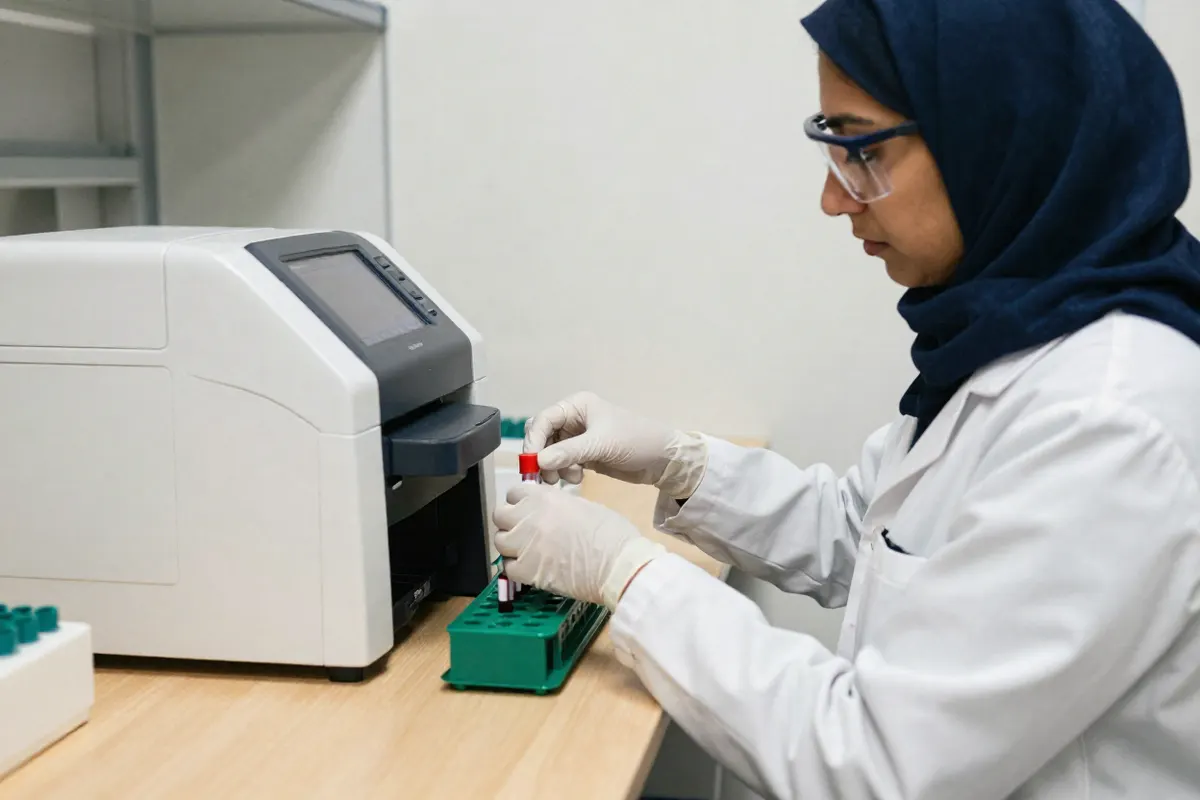
What the job is
Most medical decisions start with a lab result, and lab teams produce those results. Phlebotomists collect blood from patients, lab assistants and specimen processors label, sort and prepare samples, and medical laboratory technicians (MLTs) and scientists (MLSs) run and verify the tests on analyzers and under the microscope. Histotechs prepare tissue for pathologists and cytotechs screen cells for cancer. Phlebotomy is one of the quickest ways into healthcare, while the testing roles need a college degree and a national certification.
A typical shift
- Check each patient's identity with two identifiers, then draw blood by venipuncture or fingerstick in the right tube order
- Label, log and spin specimens, then route them to chemistry, hematology, blood bank or a reference lab
- Run patient samples on analyzers after quality control passes, and review results before they post to the chart
- Call critical values to the nurse or provider within minutes and document who took the call
- Crossmatch blood for transfusion, read slides, culture specimens, or embed and cut tissue, depending on the bench
- Keep instruments calibrated and maintained, and follow strict infection control around blood and sharps
What a shift looks like
Morning draw rounds
At 4 a.m. a hospital phlebotomist works through a list of inpatients who need labs before the doctors round. A patient on the cardiac floor has rolling veins, so she switches to a smaller needle, gets the draw on the second try and has the tubes in the lab before the 6 a.m. cutoff.
A critical potassium
On the night shift in the core lab, an MLS sees a potassium result far above the critical limit. She checks the sample for hemolysis, reruns it, then calls the nurse, reads the value back and documents the call in the lab system.
Emergency blood
A trauma patient arrives bleeding and the blood bank gets an urgent request. The tech issues uncrossmatched O-negative units first, then types the patient's sample and crossmatches compatible units for the next round.
Who does well in this job
Lab work suits people who like precision, routine and science, and who stay calm when a result has to be right the first time. Phlebotomists also need warmth and steady hands, because they meet anxious patients, children and people who faint at the sight of a needle. Many people start in phlebotomy straight out of high school or after retail or military service, while lab scientists often come from biology or chemistry degrees. Medical assistants and nursing students also pick up phlebotomy skills on the way to other roles.
You will likely enjoy it if
- You notice small details and double-check your work without being told
- You can follow a written procedure exactly, every time, even at 3 a.m.
- You are comfortable around blood, needles and body fluids
- You like science and problem-solving more than being at the center of attention
What you need
- A high school diploma or GED (required by most phlebotomy programs and certification exams)
- A phlebotomy training program with supervised live draws, plus national certification for most phlebotomy jobs
- For MLT or MLS roles: an associate or bachelor's degree with lab science coursework and a clinical rotation, usually followed by ASCP certification
- A state license or certificate where one is required, and passing a background check, drug screen and immunization review
Skills that help
Your path into the job
- 1Decide your entry point: phlebotomy or specimen processing to start working fast, or an MLT or MLS degree if you want to run tests
- 2Check whether your state licenses phlebotomists or lab staff (California, Louisiana, Nevada and Washington have phlebotomy rules) before you pick a program
- 3Enroll in an accredited program that guarantees a clinical site, and log every successful draw or rotation hour
- 4Sit for a national exam such as NHA CPT, ASCP PBT or AMT RPT for phlebotomy, or ASCP MLT or MLS for testing roles
- 5Apply to hospital phlebotomy teams, outpatient draw sites, reference labs and specimen processing roles, and say yes to nights or weekends if that gets you in
- 6Once hired, ask about tuition help and internal training so you can move up the lab ladder
Common misconceptions
Myth: A phlebotomy certificate lets you draw blood in any state.
Reality: A few states add their own rules. California requires its own state certificate, Louisiana licenses phlebotomists, Nevada certifies them as lab assistants and Washington issues a medical assistant-phlebotomist credential.
Myth: Machines do all the testing now, so lab jobs are disappearing.
Reality: Analyzers automate steps, but trained people run quality control, troubleshoot, review results, crossmatch blood and read slides. Labs report hard-to-fill openings across most departments.
Myth: Phlebotomy is a dead end.
Reality: Drawing blood or processing specimens is a common first step into the lab. Experience in a certified lab counts toward some certification routes, and many MLTs and MLSs started on the draw team.
What it pays
Open lab jobs that post a rate typically pay $20–$55/hr today, with a live median of $30 an hour across the 6,579 open jobs that state one.
The complete guide
Everything about lab jobs
Written by CareJobs.Now
CareJobs.Now reads every job and the pay it states from the employer's own job board each night, and takes a job down once its employer does.
How to become a phlebotomist or lab tech in 2026: the work, the training, the exams and the first job
About 343,000 people worked as clinical laboratory technologists and technicians in the United States in 2025 - BLS, and another 143,900 worked as phlebotomists - BLS. Together they produce the blood counts, chemistry panels, cultures, blood bank crossmatches and tissue slides that most diagnoses depend on, and almost none of the patients they help ever learn their names.
That invisibility is part of why lab careers are so misunderstood. People assume phlebotomy is a dead end, that machines now do all the testing, or that a biology degree is enough to walk into a hospital lab. None of those is right. The lab is one of the few places in healthcare with a clear ladder you can climb in steps: start drawing blood within months, move into specimen processing or a technician role, then earn a degree and a national certification and run the tests yourself.
This guide is for anyone deciding whether to work in a lab, choosing a program, or trying to land a first job. It covers what each lab job really is and how it differs from the jobs next to it, what a shift looks like hour by hour, the training routes and how to choose one, the national certifications and the states that license lab staff, what employers screen for, the career ladder, and the hard parts nobody puts in the brochure. If you mainly want pay figures by state and setting, the companion guide on lab tech and phlebotomist jobs and pay covers that in depth.
Contents
- What lab work really is
- A lab shift, hour by hour
- Training paths: phlebotomy, MLT, MLS and paid programs
- Certification and state licenses
- Getting your first lab job
- The lab career ladder and what each step takes
- The hard parts and how people handle them
- Outlook and how to decide
1. What lab work really is
A hospital or reference lab is a production line for information. A doctor or nurse orders a test, someone collects the specimen, someone labels, spins and routes it, someone runs it on an analyzer or reads it under a microscope, and someone checks that the result makes sense before it posts to the chart. Each of those steps is a job, and the titles map onto them fairly cleanly once you see the line.
Phlebotomists collect the specimens, mostly blood, by venipuncture or fingerstick. Lab assistants and specimen processors receive, label, centrifuge, aliquot and route samples, and in many labs they also draw blood. Medical laboratory technicians (MLTs) and medical laboratory scientists (MLSs, also called medical technologists or clinical laboratory scientists) run and verify the tests. Technologists can specialize in blood bank, clinical chemistry, cytotechnology, hematology, histotechnology, microbiology or molecular biology, and histotechnicians cut and stain tissue specimens - BLS.
How the lab jobs differ from each other
The clearest way to separate the lab jobs is by the training they take and what they are allowed to do. The table below sets them side by side.
| Job | Typical training | Usual credential | Core work |
|---|---|---|---|
| Phlebotomist | Certificate program, usually under 1 year, or on-the-job training | National certification preferred; state certificate or license in a few states | Patient ID, blood draws, labeling, specimen handling |
| Lab assistant or specimen processor | On-the-job training, often after phlebotomy | Often a phlebotomy certificate | Receiving, spinning, aliquoting and routing samples |
| MLT | Associate degree in lab science or medical lab technology | National certification (often ASCP MLT); state license in licensure states | Running and verifying routine and many complex tests |
| MLS (MT, CLS) | Bachelor's degree plus an accredited program or qualifying coursework | National certification (often ASCP MLS); state license in licensure states | Full testing menu, troubleshooting, blood bank, quality control |
| Histotech | Certificate or degree route | Histotechnician or histotechnologist certification | Processing, embedding, cutting and staining tissue |
The phlebotomist route is short: most people enter with a certificate from a program that usually takes less than 1 year, and some employers hire high school graduates and train them on the job - BLS. The testing roles take a college degree. Lab technologists and technicians typically need a bachelor's degree to enter the occupation, though technicians sometimes qualify with an associate degree - BLS.
How the lab differs from the jobs next to it
Several neighboring jobs also draw blood, which is where the confusion starts. Medical assistants draw blood in clinics as one task among many, and nursing assistants and patient care techs often do it on hospital floors. The difference is focus and depth: a phlebotomist draws all day, from infants to frail older adults, and becomes the person the floor calls when nobody else can get a vein. If the broader clinic role appeals to you more, read the guide to becoming a medical assistant.
On the testing side, the closest neighbors are other technical jobs with a similar degree. The chart below compares May 2025 national medians for lab work and several occupations the BLS lists as similar.
The chart makes one point plainly: a degree-level lab job pays in the same band as other science technician jobs, and well above phlebotomy. The gap between the phlebotomist median of $45,230 and the lab technologist and technician median of $62,930 is the price of the degree and certification, and it is the main reason so many phlebotomists study part time to move to the bench.
2. A lab shift, hour by hour
No two labs run exactly alike, but hospital lab days follow a recognizable rhythm because they are built around when doctors round and when results are needed. The two examples below are composites of a hospital phlebotomist's early shift and a core lab scientist's night shift, not one real person's day.
Most lab staff work full time, often on shifts that include nights, weekends or holidays - BLS. Hospitals never close, so neither does the hospital lab.
A hospital phlebotomist, early shift
4:00 a.m. Morning draw rounds. You pick up a list of inpatients who need labs before the doctors round. On each floor you check the order, find the patient, and confirm identity with two identifiers (name and date of birth) against the wristband before you touch a needle. You wake patients gently, explain what you are doing, and draw in the correct order of tubes so additives do not contaminate the next sample.
6:00 a.m. The cutoff. Rounds are timed so results are ready when the care teams meet. You carry or tube your samples to the lab, and the hardest part of the morning is the patient you could not get: rolling veins, a dialysis arm you cannot use, a patient who refused. You note each one and come back, or escalate to a senior phlebotomist.
8:00 a.m. Outpatient draws or stat calls. Many hospital phlebotomists then work the outpatient draw station or answer stat calls from the emergency department and the floors. A stat draw means stop what you are doing and go. A pediatric draw means a parent in the room, a frightened child, and a technique that has to be right the first time.
12:30 p.m. Hand-off. You restock trays, check that every specimen you collected is received, and hand open orders to the next shift. A specimen that sits unlabeled or mislabeled is not a small error: the lab rejects it, and the patient gets stuck again.
A core lab scientist, night shift
11:00 p.m. Start of shift. You take report from the evening scientist: which analyzers are down, which samples are pending, any critical values not yet called. You run quality control on each analyzer and do not report a patient result until QC passes.
1:00 a.m. Stat work. Samples from the emergency department arrive in bursts. You run troponins, chemistry panels, blood counts and coagulation tests, review each result against the patient's history and the analyzer flags, and release them. A potassium far above the critical limit means checking the sample for hemolysis, rerunning it, then calling the nurse, reading the value back, and documenting who took the call.
3:00 a.m. Blood bank. A bleeding patient needs blood. If you are cross-trained in blood bank, you type the patient's sample, screen for antibodies and crossmatch compatible units, while emergency-release units go out first if the team cannot wait.
5:00 a.m. Morning draws arrive. The morning draws from the phlebotomy team start landing, and the lab has to turn hundreds of samples around before the doctors round. Then you hand off to the day shift: instrument status, pending work, any problem samples.
How the day changes by setting
The rhythm above shifts with the setting. In a reference lab, most samples arrive by courier from doctors' offices and testing runs in large batches, often on evening and night shifts. In an outpatient draw site, phlebotomists work business hours with appointments and walk-ins, and the work is steady rather than urgent. Mobile phlebotomists drive to patients' homes and draw alone, which suits experienced people who are confident with difficult veins. Histology runs on a day schedule built around the morning pathology sign-out, with tissue processed overnight.
3. Training paths: phlebotomy, MLT, MLS and paid programs
There are five main ways into lab work, and the right one depends on how fast you need to earn and how far up the ladder you want to go. The short routes get you drawing blood in weeks or months. The degree routes take two to four years but lead to the testing jobs, which pay more and are harder to replace.
Each route also sets up the next one. A phlebotomy job puts you inside a lab, where you learn how specimens move and who does what, and lab experience can count toward some certification routes later. A degree without lab experience gets you certified but not necessarily hired, which is why programs build in a clinical rotation.
- Phlebotomy certificate: a short program at a community college, vocational or technical school, usually under a year.
- Paid hospital training: an employer hires you as a trainee, trains you and pays you, in exchange for a work commitment.
- MLT associate degree: about two years of lab science courses plus a clinical rotation.
- MLS bachelor's degree: a four-year degree with an accredited lab science program, or a one-year program after a science degree.
- Military training: a long military lab course that qualifies under federal lab rules.
The phlebotomy certificate is the most common starting point because it is short and leads straight to a job. The MLT degree is the most efficient way to reach the bench if you do not already have a bachelor's degree. The MLS route is right if you have a science degree already or want the widest choice of jobs. Paid training is the best deal when you can get it, and the military route is a real path for people who serve.
Phlebotomy programs
A phlebotomy program teaches anatomy, infection control, patient identification, the order of draw, specimen handling and how to handle a fainting or difficult patient, then puts you in a clinical setting to draw on real people. The number of successful draws matters, because certification bodies and states count them. California, for example, requires 40 hours of classroom training plus 40 hours of clinical practice that includes at least 50 venipunctures and 10 skin punctures for applicants without on-the-job experience - CDPH.
When you compare programs, ask how many supervised live draws each student completes, where the clinical site is and whether the program guarantees one, which national exam it prepares you for, and how many graduates pass and are hired. A program that only practices on mannequins does not prepare you for the patient with rolling veins at 4 a.m.
Paid hospital training
Some health systems pay people to train as phlebotomists, because they cannot hire enough experienced ones. Providence runs an Earn-to-Learn paid internship in Washington: trainees are hired as clinical student interns for a 6-week program of 40 hours a week, complete at least 100 clinical hours and 100 successful draws, and commit to 24 months as a phlebotomist at participating Providence labs - Providence. Graduates qualify for the optional ASCP exam.
Programs like this trade freedom for security: you train for free and start with a job, but you owe the employer time, and leaving early can mean repaying costs. Read the commitment terms before you sign. On this site, 60 lab jobs mention a trainee role right now, which is a quick way to see whether any employer near you trains from scratch.
MLT and MLS degrees
The testing jobs run through accredited lab science programs. The main accreditor is NAACLS, whose accredited programs grew from 552 in 2010 to 614 in 2024 and produce about 8,800 graduates a year - NAACLS. Programs named the availability of clinical facilities and the number of qualified applicants as their top barriers to growth, which means seats in good programs can be competitive.
An MLT program is usually an associate degree with chemistry, biology and lab courses followed by a clinical rotation through the main benches. An MLS program is either a four-year bachelor's degree with the lab program built in, or a one-year program for people who already have a science degree. If you have a biology or chemistry degree, that second route is the fastest path to the bench, and some programs take 2 years or less for people with the right coursework - BLS.
What federal rules say about who may test
Federal CLIA rules set minimum qualifications for anyone who performs high-complexity testing. They accept a bachelor's, master's or doctoral degree in a chemical, biological, clinical or medical laboratory science or medical technology, and they also accept an associate degree in a laboratory science or medical laboratory technology from an accredited institution - 42 CFR 493.1489. The same rule accepts at least 60 semester hours with set science coursework plus approved lab training, and an official US military medical laboratory procedures course of at least 50 weeks.
That federal floor matters because it means an MLT is a real bench job, not a helper role, in most of the country. But states can set higher rules, and several do, which is the subject of the next section.
4. Certification and state licenses
Most lab jobs do not require a state license, but almost every employer wants a national certification for the testing roles, and many prefer one for phlebotomy. Certification is not always required, but employers may prefer certified workers, and completing an accredited program is typically required to sit for the exam - BLS.
How much certification matters depends on the bench. In the 2024 ASCP vacancy survey, only 24.4% of phlebotomy employers required certification for hire, against 73.0% in blood bank and 84.8% in cytology - AJCP. In the same survey, 38.3% of phlebotomy staff were certified, against 82.4% of blood bank staff. Phlebotomy is the bench where certification helps you stand out rather than simply get in the door.
Phlebotomy certifications
Several organizations certify phlebotomists, and the big three in job postings are ASCP, AMT and NHA. California's list of approved certifying organizations shows the field: it accepts exams from the American Certification Agency, AMCA, AMT, ASCP, NCCT and NHA - CDPH.
| Credential | Issued by | Clinical requirement | Fee | Note |
|---|---|---|---|---|
| PBT(ASCP) | ASCP Board of Certification | Training or experience route set by ASCP | $155 application fee - ASCP | The same board certifies MLT and MLS |
| RPT(AMT) | American Medical Technologists | 50 venipunctures and 10 skin punctures on every route - AMT | $125, including the first annual fee - AMT | Routes by education, work-based learning or work experience |
| CPT(NHA) | National Healthcareer Association | Set by NHA; check its current handbook | Check NHA's current fee | Widely used by career schools; accepted in California - CDPH |
AMT's routes show how flexible certification can be. You can qualify with an approved course of at least 120 classroom hours, with 40 classroom hours plus 160 hours of guided work experience, or with at least 1,040 hours of phlebotomy work in the past 3 years, which AMT describes as about six months of full-time work - AMT. That last route means a phlebotomist trained on the job can certify later without going back to school.
MLT and MLS certification
For the testing jobs, the dominant credentials are the MLT(ASCP) and MLS(ASCP) from the ASCP Board of Certification, and the ASCP exams are also the gateway to state licenses. New York, for instance, requires a passing score on an ASCP Board of Certification exam, a converted score of at least 75, for its clinical laboratory technologist license - NYSED. AMT also offers lab technologist and technician credentials, and New York accepts current AMT MLS certification as one of its education alternatives.
Timing matters. Many programs schedule the certification exam soon after graduation, and NAACLS measures programs on pass rates for exams taken within the first year after graduation - NAACLS. Ask any program you consider for its three-year pass rate, its graduation rate and its job placement rate. Accredited programs publish them.
States that license lab staff
A handful of states license lab staff directly, and if you live in one, the license is the real gate. Only 12 US states and territories require state personnel licensure for medical laboratory scientists: California, Florida, Hawaii, Louisiana, Montana, Nevada, New York, North Dakota, the Northern Mariana Islands, Puerto Rico, Tennessee and West Virginia - Lincoln Memorial University disclosure, May 2026. Phlebotomy rules are a separate list, and a few states that do not license scientists still regulate phlebotomists.
| State | What the rules say | Source |
|---|---|---|
| California | Phlebotomists need a state CPT I certificate: training at a state-accredited program, 50 venipunctures and 10 skin punctures, a national exam from an approved agency, and annual renewal with continuing education. Lab scientists need a state CLS license | CDPH |
| New York | Clinical laboratory technologists need a state license: at least 18, one of seven education routes, a passing ASCP exam, and a $345 license and first registration fee | NYSED |
| Louisiana | The medical board licenses six lab categories, including phlebotomist and laboratory assistant; phlebotomists need a board-approved national exam and pay a $40 licensure fee | LSBME |
| Washington | Phlebotomists hold a Medical Assistant-Phlebotomist credential: high school or equivalent plus an accredited or practitioner-attested phlebotomy program; no exam is required | Washington DOH |
The practical lesson is to check your state before you choose a program, not after. California's rules are the strictest for phlebotomy: on-the-job experience as unlicensed lab staff in California does not count toward its licenses, except for medical assistants drawing blood in a physician's office or clinic that is not also a licensed testing lab - CDPH. If you plan to move to a licensure state, factor in the application time, the fee and any extra coursework, since California, for example, adds a physics requirement that some bachelor's programs do not meet.
5. Getting your first lab job
The good news is that labs hire new people constantly, and phlebotomy in particular is a job employers struggle to keep filled. In the 2024 ASCP survey, phlebotomy staff vacancies took up to 7 months to a year to fill, longer than the 3 to 6 months reported for most departments, and night shifts, overtime and double shifts were hard to staff - AJCP. Right now this site lists 15,885 open lab and phlebotomy jobs.
The challenge for a new graduate is not finding an opening but getting through the screen for the opening you want. Employers look at a short list of things, and most of them you can control before you apply.
- Certification or a test date: certified, or scheduled to sit for the exam within weeks.
- Live draws: a number you can state, from your program or clinical site.
- Basic Life Support: some employers ask for it - BLS.
- A driver's license: needed for roles that transport samples or draw in homes.
- Schedule flexibility: willingness to work early mornings, nights or weekends.
The certification line is a filter for many hospital and reference lab postings, so if you are not yet certified, put your exam date on your application. The live-draw count is where you separate yourself: a hiring manager reading "completed 120 supervised venipunctures including pediatric and geriatric patients" knows you will not freeze on day one. Schedule flexibility is often the deciding factor, because the hours that are hardest to fill are exactly the ones a new hire can take.
Expect onboarding checks too. Most employers run a background check and drug screen and review your immunizations, and the federal bloodborne pathogens standard requires employers to offer the hepatitis B vaccine at no cost within 10 working days of initial assignment to anyone with occupational exposure - OSHA. Have your vaccination records ready so your start date does not slip.
Where new lab people get hired
Hospitals and reference labs hire most phlebotomists: hospitals employ about 36% of them and medical and diagnostic laboratories 33%, with other ambulatory care at 16% and physicians' offices at 9% - BLS. For lab technologists and technicians, hospitals employ 36%, diagnostic labs 19% and physicians' offices 10% - BLS.
Each kind of employer offers a different first job. A hospital phlebotomy team gives you the widest experience (inpatients, children, the emergency department) and often the night differential. A reference lab such as Quest Diagnostics or Labcorp hires in volume for patient service centers and processing. Home-draw companies such as Getlabs, which sends mobile phlebotomists to patients' homes, suit experienced phlebotomists who like to work independently. Large health systems such as Providence and Intermountain Health run their own labs and sometimes their own training. The employers page lists every hospital, lab and care company this site reads jobs from, and 5,231 open postings mention phlebotomist in their text right now.
For a new MLT or MLS, the clinical rotation site is the most common first employer. Treat the rotation as a long interview: learn every bench, ask to run QC, and tell the supervisor you want to be hired. If you want to understand how a large system moves you from application to offer, read how hospital hiring works.
Resume and interview points specific to the lab
A lab resume should be short and specific. Put your certification (or exam date), your state license if your state requires one, and your BLS card at the top. Under your training, list numbers: venipunctures and skin punctures performed, age groups drawn, benches rotated through, analyzers and lab information systems used. If you processed specimens or worked in a lab in any role, say so, because lab experience is rare among new applicants.
Lab interviews test judgment more than knowledge. Expect questions such as: what do you do if a specimen arrives unlabeled, what is the order of draw and why does it matter, what do you do if a patient faints during a draw, what happens after a needlestick, and how would you handle a critical value you cannot reach anyone about. The right answers all share one idea: patient safety and specimen integrity come first, and you follow the procedure even when it is slower. The healthcare job interview guide covers common questions and how to answer them.
6. The lab career ladder and what each step takes
The lab has one of the clearest ladders in healthcare, and most of the steps are credentials rather than years. You can climb it while you work, which is how many scientists started.
The first rung, from phlebotomist to lab assistant or specimen processor, is a lateral move in pay but a big one in learning: you see the whole lab and find out which bench interests you. The big rung is the move to the bench as an MLT or MLS, which takes a degree and certification. Many people do it in steps, finishing an MLT associate degree while drawing blood and then completing a bachelor's degree for the MLS later, since the associate credits usually carry over.
Specialist, lead and manager roles
After the bench, the ladder branches. Specialty certification is available in areas such as histology and clinical chemistry - BLS, and specialists in blood bank, microbiology and molecular diagnostics are among the hardest people for labs to replace. Lead technologist, supervisor and manager roles add responsibility for a shift or a department, and they reward people who teach well and stay calm when an analyzer fails at 2 a.m.
There are also branches outside the core lab. Pathologists' assistant programs, a graduate-level route into anatomic pathology, grew 45% from 2015 to 2024 - NAACLS. Many phlebotomists also use the job as a step into nursing, medical assisting or imaging. If you are weighing those options, the guides to becoming a nurse, imaging careers and allied health jobs cover the paths.
What the climb is worth
The value of each step shows in the pay gap. The median for lab technologists and technicians is $62,930 against $45,230 for phlebotomists, and the top tenth of lab technologists and technicians earn more than $100,990 - BLS. That top tenth is mostly experienced specialists, leads and managers, often in high-paying states.
Experience alone moves pay more slowly. The phlebotomist band is narrow, from under $35,780 for the lowest tenth to above $58,780 for the highest - BLS, so a phlebotomist who wants a large raise usually gets it by changing jobs within the lab rather than staying longer at the draw station. Ask every employer whether it offers tuition help toward an MLT or MLS degree. The companion lab pay guide shows where pay is highest by setting and state.
7. The hard parts and how people handle them
Lab work is steady and respected, but it has real hard parts, and the people who last go in knowing them. The biggest are exposure to blood and sharps, the physical strain of standing and repetitive work, the hours, and the weight of responsibility for results nobody double-checks after you.
None of these is a reason to avoid the lab. They are reasons to choose your employer carefully, set good habits in your first weeks, and plan your path up the ladder.
Needles, blood and infection
Sharps injuries are a known risk in any job that uses needles. The CDC estimates about 385,000 needlesticks and other sharps injuries to hospital-based healthcare personnel each year - CDC. Lab staff also handle infectious specimens and other biohazards, which is why they wear masks, gloves and goggles and follow strict safety protocols - BLS.
Federal rules put most of the burden on the employer. Under the OSHA bloodborne pathogens standard, contaminated needles must not be bent, recapped or removed unless no alternative is feasible, training must be repeated at least annually, and the exposure control plan must be reviewed and updated at least annually - OSHA. How people handle it: activate the safety device on every needle, put sharps straight into the container, never reach into a sharps bin, and report every exposure at once so it can be evaluated and treated.
Standing, repetition and the hours
The physical load is different from bedside care but real. Lab technologists face long periods of standing and repetitive motion injuries - BLS, and phlebotomists may stand for long periods too - BLS. Pipetting, uncapping tubes and leaning over patients add up over years. Supportive shoes, a bench set at the right height, rotating tasks and using automated decappers where the lab has them help more than people expect.
The hours are the other strain. Night shifts carry a higher risk of accidents and errors: NIOSH training material reports a 28% higher risk on night shifts and 15% on evening shifts compared with day shifts, and 28% on 12-hour shifts compared with 8-hour shifts - NIOSH. Many lab people start on nights because that is where the openings are. If you do, protect your sleep with a fixed schedule, a dark room and a plan for your days off, and treat a move to days as a goal, not a given. The guide to shift differentials explains what nights should pay you for the trouble.
Responsibility and turnover
The emotional weight of lab work is quieter than on a nursing floor, but it is there. A mislabeled tube, a missed critical value or a wrong blood type can harm a patient, and the lab is often the last check before a result reaches the chart. People who thrive treat procedures as protection, not bureaucracy, and they speak up when something looks wrong.
Staffing pressure makes that harder. In the 2024 ASCP survey, 54.2% of respondents reported terminations in the previous six months - AJCP, and short-staffed benches mean more overtime for the people who stay. Ask in interviews how the lab covers call-outs, how often staff are asked to work doubles, and whether there is cross-training, because a lab where everyone can cover two benches is a lab where you get your days off.
8. Outlook and how to decide
The long-run outlook is steady for scientists and faster for phlebotomists. The BLS projects lab technologist and technician jobs to grow 3% from 2025 to 2035, with about 20,800 openings a year, and notes that automation of lab workflows may dampen demand - BLS. Phlebotomist jobs are projected to grow 7%, much faster than average, with about 18,000 openings a year - BLS.
Most of those openings come from people retiring or changing careers, not from growth, and that is where the specialized benches stand out. In the 2024 ASCP survey, managers expected 29.5% of molecular pathology staff, 25.3% of cytogenetics staff and 21.0% of histology staff to retire within five years, against 8.4% in phlebotomy - AJCP. Phlebotomy openings come mostly from turnover as people move on, while the specialty benches face a retirement wave. For how lab work compares with other growing jobs, see the guide to the fastest-growing healthcare jobs in 2026.
A decision framework
Lab work is probably a good fit if most of these are true:
- You like precision: you double-check your work without being told.
- You are fine with blood: needles, body fluids and specimens do not bother you.
- You like routine: following a procedure exactly, every time, feels right rather than dull.
- You want a ladder: you would rather climb in clear steps than make one big leap.
If you want long conversations with patients, a nursing or medical assistant path may suit you better, because most lab staff never see the patient whose sample they test. If you dislike science classes, phlebotomy can still work, but the bench roles demand chemistry and biology. If you need a high income quickly, compare the phlebotomy median with your local cost of living before you commit, and plan the degree as your second step.
How to start this month
If you decide to go ahead, start with your state. Check whether it licenses phlebotomists or lab scientists, using the table above and your state health department. Then pick your entry point: a phlebotomy program if you want to start earning soon, or an MLT or MLS program if you are ready for a degree or already hold a science degree. Ask each program for its pass, graduation and placement rates and whether it guarantees a clinical site.
At the same time, look for paid training. Search the lab jobs on this site for trainee and entry roles near you; postings that state pay currently offer $20 to $55 an hour, and the states page shows where the openings are. Then commit to the route that fits your budget and schedule, and plan to sit for certification within a few months of finishing. The lab rewards people who are careful, steady and willing to climb, and it has room for every step of that climb.
This guide reflects lab training, certification and state licensing rules as of October 2026. Rules, fees and pay change: check the linked source before you rely on a figure.
Frequently asked questions
Do I need a state license to be a phlebotomist?
In most states, no: employers simply expect national certification. California requires a state Certified Phlebotomy Technician I certificate (CDPH), Louisiana licenses phlebotomists through its medical board (LSBME), Nevada certifies them as laboratory assistants (NAC 652.4855) and Washington issues a Medical Assistant-Phlebotomist credential (Washington DOH).
Which phlebotomy certification should I get: NHA, ASCP or AMT?
All three are widely recognized, and California accepts each of them for its state certificate (CDPH). NHA's CPT asks for 30 venipunctures and 10 capillary or finger sticks on live people (NHA), while AMT's RPT asks for 50 venipunctures and 10 skin punctures (AMT). Pick the one your program prepares you for and your target employers list in their postings.
What is the difference between an MLT and an MLS?
Technologists (MLS, also called MT or CLS) typically hold a bachelor's degree, while technicians (MLT) typically hold an associate degree (BLS). Federal CLIA rules let people with an associate degree in lab science perform high-complexity testing (42 CFR 493.1489), but some states narrow that: California's MLT license covers waived and moderate-complexity tests only (CDPH). See what each pays on lab tech and phlebotomist jobs.
Is there really a shortage of lab workers?
Yes. The ASCP 2024 Vacancy Survey found staff vacancy rates from 6.7% in cytogenetics to 28.6% in anatomic pathology, with histology at 21.0% (AJCP). The BLS also projects phlebotomist jobs to grow 7% from 2025 to 2035, much faster than average (BLS).
I already have a biology degree. How fast can I become a lab scientist?
Faster than starting over: some lab science programs take 2 years or less for people who already have a bachelor's degree or the right coursework (BLS). In California, a CLS license needs a bachelor's with set chemistry and biology hours plus at least one year of post-baccalaureate clinical training (CDPH). Read the full path in our lab careers guide.
Related kinds of job
Medical Assistants
Clinic team members who room patients, take vitals, give injections and keep the provider's day on track.
Radiology & Imaging Techs
Take the X-rays, CT and MRI scans and ultrasounds that doctors use to find what is wrong inside the body.
More Allied Health
The specialists who feed, monitor, interpret for, counsel and support patients beside the nurses and doctors.