Hands-on patient care
How to Become a CNA or Patient Care Tech
Hands-on caregivers who help patients bathe, eat, move and stay safe, and tell the nurse when things change.
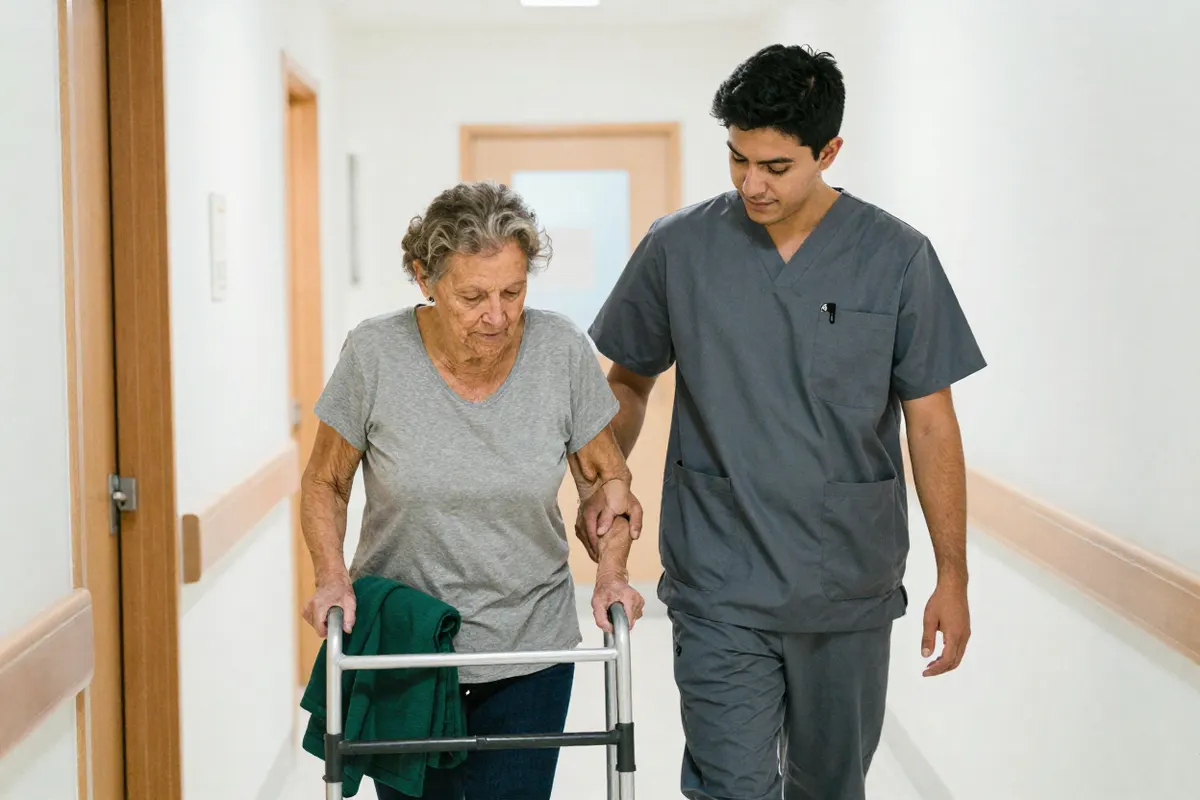
What the job is
Nursing assistants (CNAs) and patient care technicians (PCTs) give the everyday, hands-on care that keeps patients clean, fed, comfortable and safe. They help people bathe, dress, use the bathroom, eat and walk, take vital signs, and report changes to the nurse. CNAs finish a short state-approved training program and pass a state competency exam to get on the state's nurse aide registry. Hospital PCTs often add skills such as drawing blood or running EKGs.
A typical shift
- Help patients bathe, dress, use the bathroom, eat and move between bed, chair and walker
- Take vital signs, weights, blood sugars and intake and output, and record them
- Turn and reposition patients who cannot move on their own to prevent pressure injuries
- Answer call lights, keep rooms safe and help prevent falls
- Tell the nurse right away when a patient seems different: new confusion, pain, breathing trouble or a high reading
- On hospital units, draw blood, run EKGs or sit with patients who need one-to-one observation, depending on training
What a shift looks like
Morning care in a nursing home
You have ten residents on your hall. You help each one wash, dress and get to breakfast, use a mechanical lift for a resident who cannot bear weight, and notice that another barely touched her food, which you report to the nurse.
A night shift on med-surg
As the PCT for two nurses' patients, you do vital signs at midnight and 4 a.m., help a post-op patient walk to the bathroom and draw the morning labs. One blood pressure is much lower than before, so you recheck it and tell the nurse straight away.
A sitter assignment
You stay with a confused patient who keeps trying to climb out of bed. You keep him calm, reorient him, help him to the bathroom and make sure the bed alarm and call light are within reach, documenting his behavior every hour.
Who does well in this job
This work suits people who are patient, kind and physically steady, and who find meaning in helping others with the most basic parts of life. Many CNAs and PCTs are nursing or pre-med students, career changers who want to try healthcare before a longer program, or people who need a paid job quickly. Those who thrive stay calm with confused or upset patients, notice small changes, and do not mind bodily fluids, lifting or being on their feet all shift.
You will likely enjoy it if
- You want a paid healthcare job within a few weeks or months, not years
- You are comfortable helping people bathe, eat and use the bathroom
- You can stay on your feet and lift and move people safely through a long shift
- You may want to become a nurse or another provider later and want real patient experience first
What you need
- Completion of a state-approved nurse aide training program (some states let you test without one)
- A passing score on the state competency exam (written or oral test plus a skills demonstration)
- Listing on the state nurse aide registry, plus a criminal background check in most states
- Current CPR or BLS certification for most hospital PCT and tech jobs
Skills that help
Your path into the job
- 1Check your state's nurse aide training rules and find an approved program at a community college, technical school, the Red Cross or a nursing home
- 2Ask local nursing homes and hospitals whether they pay for training or hire trainees who certify on the job
- 3Complete the classroom, lab and supervised clinical training, then schedule your state competency exam
- 4Pass the written and skills tests and confirm your name is on the state nurse aide registry
- 5Apply to nursing homes, hospitals, rehab centers and dialysis clinics; hospital PCT jobs may want extra skills such as phlebotomy or EKGs
- 6Use your first year to build skills, then consider a medication aide credential, a PCT role or a nursing program
Common misconceptions
Myth: CNA work is just cleaning up after people.
Reality: Personal care is a big part of the job, but CNAs are also the team's eyes and ears. They spend more time with patients than anyone else and are often the first to notice a fall risk, a new pressure sore or a change in breathing.
Myth: You need months of school to become a CNA.
Reality: Federal rules set a fairly short minimum for nursing home aide training, and many programs finish in a few weeks. Some states require more hours, and some employers pay for the training.
Myth: A CNA certificate is a dead end.
Reality: It is one of the most common starting points in healthcare. Many CNAs move into PCT, medication aide, dialysis tech or unit secretary roles, and many go on to become LPNs, RNs or other providers, often with tuition help from their employer.
What it pays
Open CNAs & PCTs jobs that post a rate typically pay $19–$30/hr today, with a live median of $20 an hour across the Unavailable open jobs that state one.
The complete guide
Everything about CNAs & PCTs jobs
Written by CareJobs.Now
CareJobs.Now reads every job and the pay it states from the employer's own job board each night, and takes a job down once its employer does.
How to become a CNA or patient care tech in 2026: the work, the training, the exam and the first job
About 1.5 million people worked as nursing assistants in the United States in 2025, and BLS expects about 203,300 openings a year for nursing assistants and orderlies through 2035 - BLS. That makes it one of the largest and most accessible ways into healthcare: federal rules set the minimum training for a nursing home aide at just 75 clock hours - 42 CFR 483.152.
Short training does not mean easy work. Nursing assistants do the most physical and most intimate parts of patient care: bathing, toileting, feeding, turning and walking people who cannot do it alone, often for a full shift on their feet. They are also the people who spend the most time with patients, which makes them the first to notice when someone is getting worse. Done well, it is skilled, demanding and meaningful work, and it is the first step for a huge share of nurses and other providers.
This guide is for anyone thinking about becoming a certified nursing assistant (CNA) or patient care technician (PCT): high school graduates, career changers, nursing and pre-med students, and people who need a paid healthcare job soon. It covers what the work really is and how the titles differ, a real shift hour by hour, the training routes and how to choose one, the competency exam and state registry, what employers screen for, the career ladder, and the hard parts. If you mainly want pay figures by state and setting, the companion guide on CNA and PCT jobs and pay covers that in depth.
Contents
- What nursing assistants really do (and how the titles differ)
- A nursing home shift, hour by hour
- Training paths: classes, employer-paid programs and student routes
- The competency exam, the registry and state rules
- Getting your first CNA or PCT job
- The career ladder and what each step takes
- The hard parts and how aides handle them
- Outlook and how to decide
1. What nursing assistants really do (and how the titles differ)
Nursing assistants provide basic care and help patients with daily activities such as bathing, dressing, using the toilet, eating and repositioning; they measure vital signs and report patient concerns to nurses, and some may give medications depending on their training and state rules - BLS. In practice that means you are the person who gets a resident out of bed in the morning, helps a post-surgery patient take their first walk, makes sure someone with dementia eats lunch, and notices that a usually chatty patient has gone quiet.
That noticing is the part of the job people underestimate. Nurses depend on aides to tell them about changes: new confusion, a fall, a red patch of skin on a heel, a patient who refused meals, a blood pressure that looks wrong. Many serious problems are first spotted by the aide who knows the patient best. Good aides report early and clearly, and good nurses listen.
Where they work
Nursing care facilities employ 36% of nursing assistants and hospitals 32%, with continuing care and assisted living communities at 11%, home health at 5% and government facilities at 3% - BLS. Each setting feels different. In a nursing home you care for the same residents for months or years and get to know them and their families. In a hospital the patients change daily, the pace is faster, and the job often includes more technical tasks.
The titles, sorted out
Healthcare uses many titles for closely related jobs, and postings mix them freely. The clearest way to separate them is by setting, training and credential.
| Title | Usual setting | Typical training | Credential | What sets it apart |
|---|---|---|---|---|
| Certified nursing assistant (CNA) | Nursing homes, hospitals, rehab | State-approved program | State registry listing after a competency exam | The core credential for hands-on care |
| Patient care technician (PCT) | Hospital units, emergency departments | CNA training plus extra skills, or on-the-job training | Often a CNA, sometimes a national PCT certification | Adds tasks such as blood draws and EKGs |
| Sitter or patient safety attendant | Hospitals | Short on-the-job training | Usually none beyond CPR | One-to-one observation of patients at risk of falls or harm |
| Medication aide | Nursing homes, assisted living | CNA plus a state medication course | State medication aide certificate in some states | Gives routine medications where state law allows |
| Dialysis patient care tech | Dialysis clinics | Employer training program | State or national certification within 18 months of hire | Runs dialysis treatments under an RN |
| Home health aide | Patients' homes | At least 75 hours under federal rules | Competency evaluation | Personal care at home, supervised by an RN |
Sources: BLS, 42 CFR 494.140 and 42 CFR 484.80.
The important distinction is the registry. A CNA is listed on the state nurse aide registry after training and a competency exam, and a nursing home must check that registry before letting someone work as an aide - 42 CFR 483.35. Some states add a medication aide credential that allows aides to give certain medications - BLS. PCT and sitter are job titles that hospitals define themselves, so the same title can mean different things at different hospitals; read each posting's requirements.
How it differs from the jobs next to it
A nursing assistant is not a nurse. Licensed practical nurses and registered nurses hold state licenses, give medications and treatments, assess patients and direct the care plan; aides carry out delegated care under their direction. Medical assistants are the closest cousin, but they work mainly in clinics, splitting time between clinical tasks and paperwork, while nursing assistants work mainly in hospitals and nursing homes on direct physical care. If the clinic version appeals to you more, read our guide to becoming a medical assistant. If you want to care for people in their own homes, our guide to caregiver careers covers home care.
2. A nursing home shift, hour by hour
Facilities that provide care around the clock schedule aides on nights, weekends and holidays - BLS. The example below is a plausible day shift for a CNA in a skilled nursing facility caring for about ten residents on one hall. It is a composite, not one real aide's day.
6:00 a.m. Report. You clock in and get report from the night aide and the charge nurse: who had a rough night, who fell or nearly fell, who has an appointment, who is on a new diet, who needs to be weighed. You check your assignment sheet and the care plans for anyone new.
6:30 a.m. Morning care. You start getting residents up. One needs a two-person transfer with a mechanical lift; you find a coworker rather than trying it alone. Another can walk with a walker if you stay close. You help each person wash, brush their teeth, dress, and use the toilet or change their brief, checking their skin as you go and noting anything red or broken.
7:30 a.m. Breakfast. You help residents to the dining room or set up trays in rooms. Some need cutting and setup; a few need to be fed slowly and carefully because they have trouble swallowing. You record how much each person ate and drank. One resident who usually eats everything barely touches her food, so you tell the nurse.
9:00 a.m. Vital signs and weights. You take temperatures, pulses, blood pressures and oxygen levels, and weigh the residents scheduled for it. A resident's blood pressure is much lower than usual, and he seems dizzy. You stay with him, help him lie down and get the nurse right away.
10:00 a.m. Showers and activities. Residents have scheduled showers, which take time and patience, especially for people with dementia who may be frightened of water. You keep them warm, explain each step and let them do as much as they can for themselves. In between you answer call lights, help people to the bathroom and get others to activities or therapy.
11:30 a.m. Lunch and repositioning. Lunch repeats the breakfast routine. Residents who cannot move themselves are turned and repositioned every couple of hours to prevent pressure injuries, and you document each turn.
1:00 p.m. Rounds and charting. You check on everyone, change briefs and bedding, refill water, and chart the care you gave: meals, fluids, toileting, vital signs, skin observations and any changes. Accurate charting protects residents and you.
2:00 p.m. Report and handoff. You give the evening aide a clear report: who did not eat, who seemed off, who needs extra help, what you told the nurse. You leave tired, and often proud of the morning one resident's family thanked you for.
Hospital PCT shifts follow a different rhythm. On a medical-surgical unit, a PCT might support two or three nurses, do vital signs every four hours, draw morning blood work, run EKGs, help patients walk after surgery, record intake and output, and respond quickly when a nurse calls for help. Night shift adds 4 a.m. vital signs and labs, confused patients who are awake, and fewer people around. Sitters spend the whole shift with one patient at risk of falling or harming themselves, keeping them safe and calm.
3. Training paths: classes, employer-paid programs and student routes
Nursing assistants typically complete a state-approved education program that includes instruction and supervised clinical work, then pass the state's competency exam, plus brief on-the-job training with their employer - BLS. The program is short compared with almost any other healthcare credential, but its quality varies, and the way you pay for it can vary even more.
Federal rules set the floor for programs that prepare aides for nursing homes. A program must include at least 75 clock hours of training, including at least 16 hours of supervised practical training, and students must complete at least 16 hours of training in communication, infection control, safety and emergency procedures, residents' independence and residents' rights before any direct contact with a resident - 42 CFR 483.152. Training must be performed or supervised by a registered nurse with at least two years of nursing experience, at least one of them in long-term care.
What you learn in a CNA program
The classroom part covers the body systems at a basic level, infection control and handwashing, residents' rights and privacy, communication with patients who have dementia or hearing loss, nutrition and fluids, safety and fall prevention, what to do in an emergency, and how to observe and report changes. The lab part is practice on classmates and mannequins: taking vital signs, making an occupied bed, giving a bed bath, helping with a bedpan, transfers with a gait belt, using a mechanical lift and doing range-of-motion exercises.
The clinical part is where it becomes real. Under a supervising nurse, you care for actual residents or patients for a set number of hours, usually in a nursing home. Expect to feel slow and awkward at first; everyone does. Use the clinical hours to learn the rhythm of a shift, to ask the experienced aides how they organize their time, and to practice each exam skill on real people. Students who treat clinicals as a working interview are often offered jobs at that site before they finish.
State hours differ
Many states require more than the federal minimum, and a few require far more. PHI's state-by-state table (2016) shows how much they differed; check your state's program for its current rules:
| State | Minimum training hours | Minimum clinical hours |
|---|---|---|
| Maine | 180 | 70 |
| Oregon | 155 | 75 |
| California | 150 | 100 |
| Florida | 120 | 40 |
| Illinois | 120 | 40 |
| New York | 100 | 30 |
| Texas | 100 | 40 |
| Washington | 85 | 50 |
| Pennsylvania | 80 | 37.5 |
| Ohio | 75 | 16 |
Source: PHI, Nurse Aide Training Requirements by State. Check your state's nurse aide program for current rules.
More hours usually mean more time on the floor with a supervising nurse, which most new aides find valuable. They also mean a longer program, so a course in Maine or California takes longer to finish than one in Ohio. If you plan to move, check whether your new state will accept your certificate as is.
Where to train
Approved programs run in several kinds of places, and the right one depends on your budget, schedule and plans. The common options are:
- Community colleges and technical schools: often the most thorough, sometimes with college credit you can apply to nursing later.
- Nursing homes and hospitals: employer-run programs that are often free if you agree to work there afterward.
- Private training schools: frequent start dates and evening or weekend schedules, but check approval and pass rates carefully.
- Red Cross and nonprofit programs: established courses in many areas, sometimes with financial help.
- High school career and technical programs: some let students certify before graduating.
The employer-paid route deserves special attention. A nursing home may use someone as a nurse aide for up to 4 months while they complete training and demonstrate competency - 42 CFR 483.35, which is why many nursing homes hire trainees, pay for the course and pay wages during training. That lets you earn from the first week. The trade-off is usually a commitment to stay for a period after you certify.
How to choose a program
Every approved program leads to the same exam and registry, but programs differ in how well they prepare you and how much they cost. Before you sign up, ask:
- Is it state-approved? Only approved programs qualify you for the exam in most states.
- What is the pass rate? Ask how many graduates pass the competency exam on the first try.
- Where is the clinical training? Real nursing home or hospital time beats extra classroom hours.
- What does it cost in total? Tuition, books, uniform, background check, exam fee and CPR card.
- Does it help with jobs? Some programs have direct hiring links with local employers.
Cost is the one to watch most closely. Employer-paid and some nonprofit programs cost nothing out of pocket, while private schools can charge much more for the same certificate. Ask about workforce grants too: many states and local workforce boards pay for CNA training for eligible residents.
Routes for nursing and pre-med students
Many hospitals hire nursing students as patient care techs or nurse externs once they finish a semester or two of nursing school, even without a separate CNA certificate, because their nursing coursework covers the same skills. Pre-med and pre-PA students often certify as CNAs to build the paid patient care experience that medical and PA programs look for. Right now Unavailable open jobs in this category mention nursing students.
4. The competency exam, the registry and state rules
After training, you take your state's nurse aide competency exam. It usually has two parts: a written (or oral) knowledge test and a hands-on skills demonstration in which you perform several randomly chosen skills in front of an evaluator, and many states let you retake only the part you failed - Trade Career Path. After passing, you are listed on your state's nurse aide registry and can work as a CNA.
The skills test is where most nerves, and most failures, happen. Typical skills include handwashing, measuring and recording a pulse or blood pressure, transferring a patient from bed to wheelchair, helping with a bedpan, giving a partial bed bath, measuring urine output, and range-of-motion exercises. Evaluators score each critical step: forgetting to wash your hands, lock the wheelchair brakes or provide privacy can fail an otherwise perfect skill. Practice each skill aloud, in order, until it is automatic.
Testing without a program
A few states let people take the exam without completing a training program. Florida, for example, lets applicants qualify by passing the competency exam if they have a high school diploma or are at least 18, but anyone who fails the exam three times must complete an approved training program before retesting; the exam is given by Prometric - Florida Board of Nursing. Even where this is allowed, most people pass more easily after a real course.
Background checks and the registry
To work in a nursing home, an aide must be on the state registry, and some states require continuing education or a criminal background check - BLS. Certain criminal convictions, and findings of abuse, neglect or misappropriation of resident property, can bar someone from the registry or from working in nursing homes. If you have a record, ask your state's nurse aide registry how it treats your situation before you pay for a course.
Staying certified
Certification is not permanent if you stop working. If you go 24 consecutive months without providing nursing or nursing-related services for pay, federal rules require a new training and competency evaluation before you can work as a nursing home aide again - 42 CFR 483.35. While you work, nursing homes must give aides at least 12 hours of in-service training a year, including dementia management and abuse prevention - 42 CFR 483.95. States set their own renewal steps on top, so check your registry's rules every time your certificate comes up for renewal.
Rules for related roles
Home health aides follow a separate federal rule: at least 75 hours of combined classroom and supervised practical training, with at least 16 hours of classroom work before 16 hours of supervised practical training, a competency evaluation by an RN, and at least 12 hours of in-service training every 12 months - 42 CFR 484.80. Dialysis patient care technicians need a high school diploma, an approved training program run under an RN, and certification under a state or national program within 18 months of hire - 42 CFR 494.140.
5. Getting your first CNA or PCT job
New CNAs are in demand almost everywhere. Hospitals report annual turnover of about one in three for CNAs and patient care techs, 32.5% and 33.8% respectively in 2025 - NSI Nursing Solutions, so openings appear constantly. The challenge is less finding a job than finding a good one.
Nursing homes, assisted living communities and rehabilitation centers hire the most new CNAs, and many hire you before you certify. Hospitals hire new CNAs too, but some prefer a year of experience or extra skills such as phlebotomy or EKGs for PCT roles. A common path is to start in a nursing home, build confidence with lifting, personal care and time management, then move to a hospital.
What employers screen for
Employers hiring nursing assistants look for a few things, and most of them you can show on paper:
- Registry status: certified, or in training with an exam date.
- CPR or BLS card: required for most hospital jobs.
- Reliability: steady attendance in past jobs or school, and references who can say so.
- Physical readiness: the ability to lift, stand and move patients safely all shift.
- Schedule flexibility: willingness to work evenings, nights, weekends and some holidays.
Reliability matters more than anything else on that list. Short-staffed units need aides who show up on time for every shift, and managers often hire the steady candidate over the more experienced one. If you have a gap or a past attendance problem, address it briefly and honestly.
Where to look
Large hospital systems, senior living companies and dialysis providers post CNA and PCT jobs year-round. On this board that includes senior care operators such as PruittHealth and Brookdale Senior Living, dialysis providers such as DaVita and Fresenius Medical Care, and hospital systems across the country; browse them in our employer directory and narrow by state on our state pages. Right now Unavailable CNA, PCT and nurse aide jobs are open on this site, and Unavailable of them mention sitter roles, a common hospital starting job.
Your first 90 days
The first weeks on the job are an adjustment even after a good course. Expect a short orientation, a few shifts shadowing an experienced aide, and then your own assignment. The hardest part for most new aides is time: getting ten residents up, fed and cared for before lunch takes an order of tasks that only comes with practice.
A few habits help. Keep a small notebook or sheet with each patient's needs and update it during report. Do the time-sensitive tasks (vital signs, meals, scheduled turns) first, and cluster care so each visit to a room covers several needs. Ask for help with heavy transfers every time. Tell the nurse about changes right away rather than at the end of the shift. And learn the names and preferences of your residents or patients: knowing that one likes coffee before anything else, or that another is scared of the shower, makes the whole shift go better.
Resume and interview points
A CNA resume can be one page. Lead with your certification and registry number (or exam date), CPR card and any extra skills (phlebotomy, EKG, medication aide). List your clinical training site and hours, then any work experience, including non-healthcare jobs that show reliability, customer service or physical work. Mention languages you speak; they are valuable on any unit.
Interviews often ask how you would handle real situations: a resident who refuses a shower, a patient who falls, a family member who is upset, two call lights at once, or a coworker who skips steps. Answer with what you would do for the patient's safety first, how you would communicate with the nurse, and how you would document. Ask your own questions too: how many residents each aide has, how long orientation lasts, whether lift equipment is easy to get, and how often shifts run short. Our guides to how hospital hiring works and healthcare job interviews go deeper.
6. The career ladder and what each step takes
For many people, CNA work is the first rung of a long healthcare career. The skills you build (assessment by observation, communication, infection control, time management and calm in a crisis) transfer to almost every other clinical job.
Specialized aide roles. The first step up is often a role that adds skills: PCT with phlebotomy and EKGs, emergency department tech, medication aide where your state offers that credential - BLS, dialysis tech, restorative aide or unit secretary. These roles take weeks or months of extra training, often paid by the employer.
Licensed practical nurse. A practical nursing program typically takes about a year, and graduates must pass a licensing exam - BLS. LPNs earned a median of $64,400 in May 2025 - BLS, and many CNAs make this move while working part time.
Registered nurse. The RN license opens the widest range of jobs. RNs earned a median of $97,550 in May 2025 - BLS. Experience as a CNA or PCT helps in nursing school admissions and in landing a first RN job, especially at the hospital where you already work. Our guide to becoming a nurse covers the LPN and RN routes in detail.
Beyond nursing. CNA experience is a common starting point for future NPs, PAs, doctors, therapists and paramedics, because it builds the hands-on patient care hours those programs want. Some aides move into related routes such as EMT and paramedic work.
Employers often help pay for these steps. AACN notes that hospitals and other practice settings partner with nursing schools and offer tuition repayment as a recruiting tool - AACN. Ask about tuition assistance at every interview, and read the work commitment that comes with it.
7. The hard parts and how aides handle them
CNA work is honest, important and often rewarding. It is also one of the hardest jobs in healthcare on the body and the heart, and the high turnover shows it.
Injuries
Nursing assistants work in a physically demanding setting, and their injury and illness rate is among the highest of all occupations - BLS. Most injuries come from lifting, transferring and repositioning patients, and from slips and falls. Some come from confused or agitated patients who hit, kick or grab.
The protections are mostly about technique and equipment. Use mechanical lifts and slide sheets whenever the care plan calls for them, even when it feels faster to lift by hand. Get a second person for heavy transfers. Bend your knees, keep the patient close and avoid twisting. Wear supportive, non-slip shoes. Learn de-escalation for agitated patients, and report every injury and every incident. A workplace that routinely lacks lift equipment or enough staff to use it safely is a reason to look elsewhere.
Short staffing and workload
When a unit runs short, each aide's assignment grows, and there is not enough time to give everyone the care they need. That gap is one of the biggest reasons aides burn out and leave. NSI notes that hospital CNAs and PCTs virtually turn over their entire staff every three years - NSI Nursing Solutions.
You cannot fix staffing alone, but you can choose employers carefully. Ask in interviews how many residents or patients each aide usually has on your shift, how often that number goes up, and how long current aides have stayed. Talk to aides who work there if you can. A slightly lower wage at a well-staffed building is often the better job.
Nights, weekends and holidays
Because care runs around the clock, nights, weekends and holidays are common - BLS, especially for new aides. Night work usually pays a differential, explained in our guide to shift differentials, but it disrupts sleep and family life. Protect your sleep with a dark, quiet room and a consistent schedule, and do not flip back to days on every day off if you can avoid it. Once you have experience, per diem work can give you more control over when you work, as our guide to per diem and PRN jobs explains.
The emotional side
Aides form real bonds with residents and patients, and they experience loss when those patients decline or die. They also absorb frustration from patients in pain, from families who are scared, and from coworkers under pressure. For many aides, those relationships are both the best and the hardest part of the job.
What helps is having people to talk to: coworkers who understand, a supervisor who listens, and, where available, employee assistance programs. It also helps to remember how much your work matters. The comfort, dignity and safety of the people in your care depend on you more than on almost anyone else in the building.
8. Outlook and how to decide
Demand for nursing assistants is steady and enormous. BLS projects nursing assistant jobs to grow 3% from 2025 to 2035, and the bigger story is replacement: about 203,300 openings a year for nursing assistants and orderlies - BLS. Care at home is growing much faster: BLS projects home health and personal care aide jobs to grow 18.1% over the same decade - BLS.
That means a certified aide willing to work in a nursing home, hospital, home health or assisted living almost anywhere in the country can find work. Pay and conditions vary widely, so the real choice is not whether you can get a job but which job, and what it leads to.
A decision framework
CNA or PCT work is probably a good fit if most of these are true:
- You want to start soon: you need a paid healthcare job within weeks or a few months.
- You are comfortable with personal care: bathing, toileting and feeding people does not put you off.
- You are physically ready: you can stand, walk, lift and move people safely all shift.
- You want a foundation: you may want to become a nurse or another provider and want real experience first.
If personal care is a hard no for you, look at clinic-based work such as medical assisting, or front-desk and support roles. If you want to work with one client at a time in a home, caregiving may suit you better. If you already know you want to be a nurse, a CNA or PCT job while you finish prerequisites is one of the smartest moves you can make.
How to start this month
There are concrete steps you can take in the next few weeks. Look up your state's nurse aide training requirements and its list of approved programs. Call two or three local nursing homes and hospitals and ask whether they pay for CNA training or hire trainees. Ask your local workforce board about grants. Get a CPR or BLS card, which most employers want anyway. Then enroll in the program that fits your schedule and budget, and book your exam as soon as you finish.
While you train, browse the CNA and PCT jobs on this site to see which employers near you are hiring and what they ask for; right now postings that state pay typically offer $19 to $30 an hour. Compare that with other entry-level healthcare jobs on our pay overview.
Nursing assistant work will not make you rich, and some days it will ask everything you have. But it puts you at the center of patient care within weeks, teaches you skills you will use for the rest of your career, and opens the door to nursing and beyond.
This guide reflects federal and state nurse aide training, testing and registry rules as of October 2026. Rules, fees and pay change: check the linked source before you rely on a figure.
Frequently asked questions
How long does CNA training take?
Federal rules require nurse aide training programs to include at least 75 clock hours, with at least 16 hours of supervised practical training - 42 CFR 483.152. Many states require more: PHI's state table lists 120 hours in Florida and Illinois and 150 in California - PHI. Most programs finish in a few weeks to a few months.
What is the difference between a CNA and a patient care tech?
A CNA is a state-certified nursing assistant listed on the nurse aide registry, and most work in nursing homes and hospitals. Patient care tech is a hospital job title that often means CNA skills plus extras such as drawing blood, running EKGs or helping in dialysis. Many hospitals hire nursing students as techs. See current openings in our CNA and PCT jobs guide.
How much do CNAs make?
Nursing assistants earned a median of $42,260 a year in May 2025, with the lowest 10 percent under $33,940 and the highest 10 percent above $51,980 - BLS. Pay is highest in government jobs and nursing care facilities, and night and weekend differentials can add to it.
Can I work as a nurse aide before I am certified?
In a nursing home, yes, for a limited time: a facility may not use someone as a nurse aide for more than 4 months unless they have completed approved training and shown competency, and it must check the registry first - 42 CFR 483.35. Many nursing homes hire trainees and pay for their course.
Does CNA certification expire?
You need to stay active. If you go 24 consecutive months without paid nursing-related work, federal rules require a new training and competency evaluation before you can work as a nurse aide in a nursing home - 42 CFR 483.35. Nursing homes must also give aides at least 12 hours of in-service training a year - 42 CFR 483.95.
Related kinds of job
Registered Nurses & LPNs
Licensed nurses who assess, treat, give medications and watch over patients around the clock.
Caregivers & Home Health Aides
Help older adults and people with disabilities live safely at home with personal care, meals and company.
Medical Assistants
Clinic team members who room patients, take vitals, give injections and keep the provider's day on track.