Hands-on patient care
How to Become an EMT or Paramedic
Answer emergency calls, treat patients where they are and get them safely to the hospital.
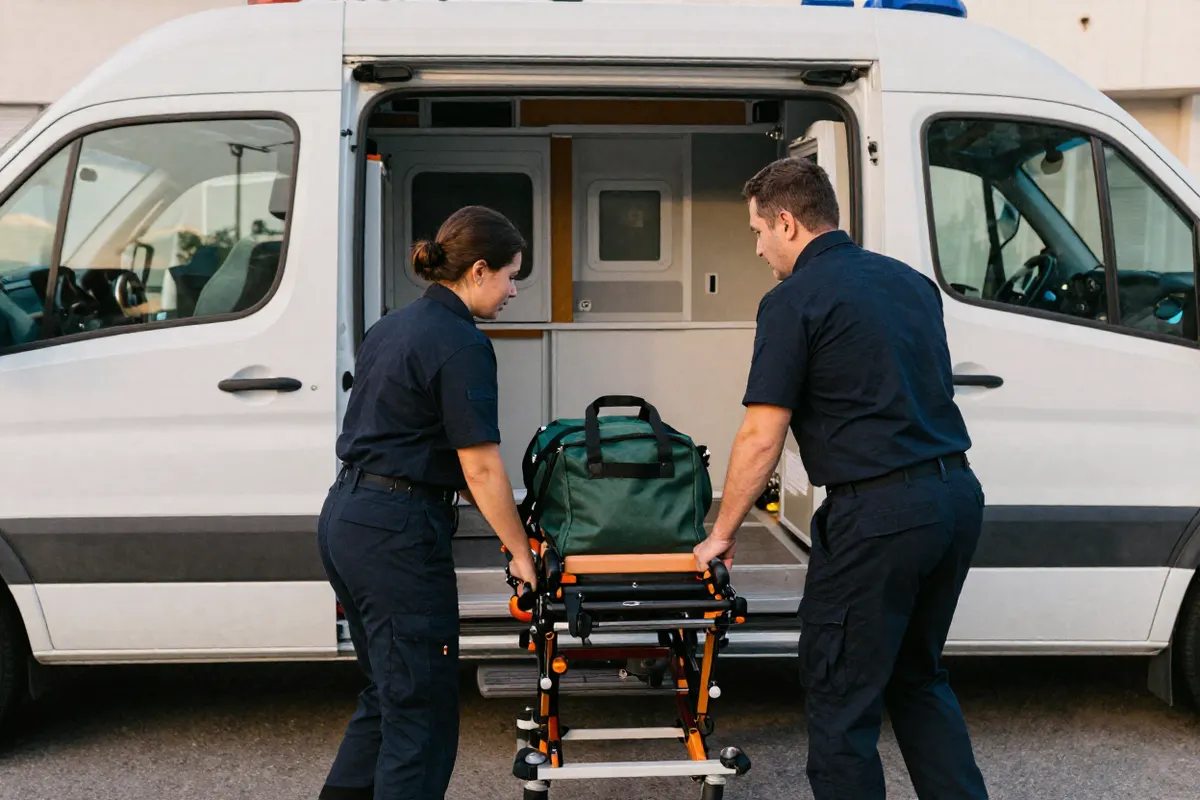
What the job is
EMTs and paramedics are the medical side of emergency response: they arrive at car crashes, homes, workplaces and nursing homes, assess and treat patients on scene, and care for them on the way to the hospital. EMTs provide basic life support, such as CPR, oxygen, splinting, bleeding control and some medications, while advanced EMTs and paramedics add IVs, advanced airways, cardiac monitoring and many more drugs. They work for private ambulance companies, fire departments and other city services, hospitals and air medical programs. An EMT course takes months, while paramedic training takes one to two years on top of EMT experience.
A typical shift
- Drive to emergencies or ride as the patient care provider, using lights and sirens safely
- Size up the scene for danger, then assess the patient's airway, breathing, circulation and vital signs
- Give treatment within your level: CPR and defibrillation, oxygen, splints, bleeding control and, for paramedics, IVs, cardiac drugs and advanced airways
- Lift and move patients on stretchers and stair chairs, often in tight spaces and bad weather
- Report to the emergency department team on arrival and write a detailed patient care report
- Clean and restock the ambulance and check every piece of equipment at the start of each shift
What a shift looks like
A cardiac arrest
A paramedic crew reaches a man who collapsed in his kitchen. The EMT takes over compressions from a family member while the paramedic places the defibrillator pads, shocks the heart, secures an airway and starts an IV, and the team gets a pulse back before loading him for the hospital.
A fall at a nursing home
An EMT crew is called for a resident who fell and has a painful, shortened leg. They check for other injuries, immobilize the leg, move her gently onto the stretcher and give the emergency department a clear report on the way in.
An interfacility transfer
A critical care paramedic and partner transfer a patient on a ventilator and two IV drips from a rural hospital to a heart center an hour away, adjusting medications and monitoring the patient the whole drive.
Who does well in this job
EMS suits people who stay calm in chaos, think on their feet and like working outside the walls of a hospital with one partner. You need physical strength for lifting, the stomach for serious injuries, and real compassion for people on the worst day of their lives. Many EMTs are students heading for nursing, medical or physician assistant school, while others come from the military, firefighting or security work and make EMS a long career. Paramedics often start as EMTs and train up after a year or two on the ambulance.
You will likely enjoy it if
- You stay steady and make decisions when things are loud and frightening
- You can lift and carry patients and work long shifts on your feet
- You want hands-on emergency care without spending years in school first
- You are comfortable working nights, weekends and holidays
What you need
- A state-approved EMT course, and for paramedics an accredited paramedic program plus prior EMT certification
- A state EMS license, which in most states requires passing the National Registry (NREMT) exams
- A minimum age, a background check and, for most employers, a valid driver's license
- CPR certification and the physical ability to lift and move patients
Skills that help
Your path into the job
- 1Check your state EMS office's rules for age, background checks and which exams it accepts
- 2Take a state-approved EMT course at a community college, fire academy or private training center
- 3Pass the NREMT cognitive exam and the state-approved skills exam, then apply for your state license
- 4Apply to private ambulance services, fire departments and hospital emergency departments, and get a driver's license if you do not have one
- 5Work a year or more as an EMT, learning to run calls, before deciding on paramedic school
- 6For paramedic, choose an accredited program and ask employers about tuition help or paid paramedic training
Common misconceptions
Myth: EMTs and paramedics are the same job.
Reality: EMTs provide basic life support after a course of a few months. Paramedics complete much longer training and provide advanced care such as IV medications, cardiac monitoring and advanced airways, and they are paid more.
Myth: Most calls are dramatic trauma scenes.
Reality: Many calls are falls, breathing problems, chest pain, sick older adults and transfers between facilities. The dramatic calls happen, but the job is mostly careful assessment and steady care.
Myth: You have to be a firefighter to be a paramedic.
Reality: Fire departments employ many EMTs and paramedics, but private ambulance services employ about as many paramedics as local government does, and hospitals hire EMTs and paramedics too.
What it pays
Open EMS jobs that post a rate typically pay $25–$45/hr today, with a live median of $25 an hour across the 1,325 open jobs that state one.
The complete guide
Everything about EMS jobs
Written by CareJobs.Now
CareJobs.Now reads every job and the pay it states from the employer's own job board each night, and takes a job down once its employer does.
How to become an EMT or paramedic in 2026: the work, the training, the exams and the first job
About 284,100 people worked as EMTs and paramedics in the United States in 2025, and the Bureau of Labor Statistics expects that number to grow 6% by 2035 - BLS. They are the first medical people most patients see in an emergency: at the kitchen table after a collapse, on the highway after a crash, in the nursing home at 3 a.m. Whatever happens next in the hospital often depends on what they did in the first few minutes.
EMS is also one of the fastest ways into hands-on emergency care, and one of the most misunderstood. People picture a nonstop run of dramatic rescues, or assume every paramedic is a firefighter, or think an EMT and a paramedic are the same job. The reality is more ordinary and more demanding: many calls are falls, breathing problems and sick older adults, private ambulance services employ about as many paramedics as fire departments and other local governments do, and the difference between an EMT and a paramedic is a year or more of training and a large step in what you are allowed to do.
This guide is for anyone deciding whether to become an EMT or paramedic, choosing a course, or trying to land a first job. It covers what each level of EMS really is and how it differs from the jobs next to it, what a 24-hour shift looks like, the training routes, the National Registry exams and state licenses, what employers screen for, the career ladder, and the hard parts nobody puts in the brochure. If you mainly want pay figures by state and employer, the companion guide on EMT and paramedic jobs and pay covers that in depth.
Contents
- What EMS work really is
- A 24-hour shift, hour by hour
- Training paths: EMT, advanced EMT and paramedic
- The National Registry exams and state licenses
- Getting your first EMS job
- The EMS career ladder and what each step takes
- The hard parts and how people handle them
- Outlook and how to decide
1. What EMS work really is
Emergency medical services is the system that brings medical care to the patient. A 911 call is answered by a dispatcher, who sends the right unit. The crew arrives, makes sure the scene is safe, assesses the patient, treats what it can on scene, decides where the patient needs to go, and keeps treating and monitoring on the way. At the hospital, the crew hands the patient over with a verbal report and writes a detailed patient care record. Then the crew cleans the ambulance, restocks, and goes back in service for the next call.
EMS also covers work that is not 911. Interfacility transfers move patients between hospitals, nursing homes and specialty centers, sometimes on ventilators and multiple IV medications. Hospitals hire EMTs and paramedics into emergency departments. Events, industrial sites and remote work camps hire EMTs to stand by. EMTs and paramedics work for ambulance services, fire departments and other local government agencies, and hospitals - BLS.
The levels of EMS
EMS is organized in levels, and each level has its own training, exam and scope of practice. The National Registry certifies four of them, and states license them.
| Level | Typical training | National exam | What you can do |
|---|---|---|---|
| EMR (Emergency Medical Responder) | A short course | NREMT EMR exam | First aid, CPR, basic airway and bleeding control until the ambulance arrives |
| EMT | A state-approved course, typically under a year | NREMT EMT cognitive exam plus a state-approved skills exam | Basic life support: assessment, CPR and defibrillation, oxygen, splinting, a short list of medications |
| AEMT (Advanced EMT) | Additional training after EMT | NREMT AEMT exam | EMT skills plus IV access and some added medications |
| Paramedic | An accredited paramedic program after EMT | NREMT paramedic exam | Advanced life support: cardiac monitoring, advanced airways, many IV medications |
EMT-Basic programs typically take less than a year, and the intermediate level can take up to two years, offered by technical institutes, community colleges, universities and specialized facilities - BLS. Paramedic programs at community colleges usually lead to a nondegree award or an associate degree, some universities offer bachelor's degrees, and paramedics typically need prior work experience as an EMT.
How EMS differs from the jobs next to it
EMS overlaps with nursing, firefighting and emergency department work, and the lines are worth knowing. An emergency department nurse works inside the hospital with physicians a few steps away and a full team around the bed. An EMT or paramedic works in the field with one partner, often in a cramped space, in bad weather, with only the equipment on the truck, and must decide on scene what the patient needs. A firefighter-EMT or firefighter-paramedic does both fire suppression and EMS for a fire department, and the hiring process is usually longer and more competitive than for a private ambulance service.
Pay follows those differences. The chart below shows May 2025 national medians for EMTs, paramedics and several occupations the BLS lists as similar.
The chart makes the central trade-off plain. The EMT level is quick to reach and pays modestly, close to a medical assistant. The paramedic level pays over a third more and sits close to firefighters. Registered nursing pays far more, which is why many EMTs and paramedics eventually move into nursing, a path covered later in this guide.
2. A 24-hour shift, hour by hour
No two EMS systems run exactly alike, but the 24-hour shift is common enough that it is worth walking through. Some EMS workers work extended shifts of 12, 18 or 24 hours, schedules include nights, weekends and holidays, and some work more than 40 hours a week - BLS. The example below is a composite of a 911 ambulance crew of one EMT and one paramedic in a busy suburban system, not one real crew's day.
7:00 a.m. Shift change and truck check. You take the keys and the radio from the off-going crew, hear about anything broken or low, and check the ambulance from front to back: oxygen levels, the cardiac monitor and defibrillator, suction, the stretcher, medications and their expiration dates, the narcotics count with your paramedic partner, and the fuel. A missing item found now is an inconvenience. A missing item found on a cardiac arrest is a disaster.
8:15 a.m. First call: a fall. An older woman fell at home and cannot get up. You check the scene, then her: how she fell, whether she hit her head, whether she takes blood thinners, what hurts. Her hip is painful and her leg is shortened and rotated. You splint, medicate for pain within protocol, and move her carefully down a narrow staircase in a stair chair, then onto the stretcher.
10:30 a.m. Chest pain. A man in his fifties is sweating and pale. Your partner runs a 12-lead EKG on scene and sees a heart attack pattern. You give aspirin, start an IV, call ahead to activate the hospital's cardiac team, and drive to the heart center rather than the nearest emergency department. The report you give on arrival saves the team minutes.
1:00 p.m. Lunch, maybe. You eat at the station, or in the truck between calls. A crew learns to eat when it can.
3:00 p.m. A car crash. Two cars, one patient trapped. Fire and police are on scene. You triage, work with the fire crew while they free the driver, keep his spine in line, control bleeding and package him for a trauma center.
6:00 p.m. Restock and a transfer. After cleaning the truck and restocking, you run an interfacility transfer, taking a patient from a community hospital to a specialty center, monitoring and documenting the whole way.
10:00 p.m. to 6:00 a.m. The night. Some nights are quiet and you sleep in the station's bunk room. Others bring a breathing emergency at midnight, an overdose at 2 a.m. and a cardiac arrest at 4:30 a.m. You are expected to be just as sharp on the last call as on the first, which is one of the hardest parts of the job.
7:00 a.m. Hand-off. You hand the truck and your notes to the next crew, finish any patient care reports, and go home for 48 hours off.
How the day changes by setting
The rhythm above shifts with the employer. Private ambulance services often mix 911 and interfacility transfers, and many run 12-hour shifts as well as 24s. Fire departments pair EMS with fire suppression, training and station duties. Hospital emergency departments use EMTs and paramedics as techs on 8- or 12-hour shifts, starting IVs, running EKGs, splinting and helping move and monitor patients. Critical care transport and air medical teams handle fewer, sicker patients with more equipment and more training.
3. Training paths: EMT, advanced EMT and paramedic
There are two main steps into EMS, and most people take them years apart. The EMT course gets you licensed and working in months. Paramedic school takes much longer and usually comes after you have worked as an EMT, because paramedics typically need that experience - BLS. The advanced EMT level sits between the two and is common in rural systems.
Each route has its own trade-offs. An EMT course is short and inexpensive compared with most healthcare training, and it lets you find out whether you like the work before investing more. Paramedic school is a serious commitment of time and money, but it is the step that turns EMS into a career with a much higher ceiling.
- EMT course: a state-approved course at a community college, fire academy, hospital or private training center.
- Advanced EMT: additional training after EMT, adding IV access and more medications.
- Paramedic program: an accredited program, often a certificate or associate degree, with hospital and field internships.
- Employer-sponsored training: an ambulance service or fire department pays for EMT or paramedic school in exchange for a work commitment.
- Military routes: military medics and the DOD SkillBridge program for service members in their final months.
The EMT course is the universal starting point. Advanced EMT is a useful step in systems that rely on it, but many EMTs go straight to paramedic. Paramedic programs are where you should be most careful about accreditation, because the National Registry will not accept graduates of programs that are not accredited or seeking accreditation. Employer sponsorship is the best deal when you can get it, and military routes suit people transitioning out of service.
The EMT course
To sit for the National Registry EMT exam, you must complete a state-approved EMT course that meets or exceeds the National EMS Education Standards for the EMT, finish it within the past two years, and have the course program director verify your completion - NREMT. Courses teach anatomy, patient assessment, airway management, CPR and defibrillation, bleeding control, splinting, medical emergencies, childbirth, lifting and moving, and ambulance operations, and they include supervised time in an emergency department or on an ambulance.
When you compare EMT courses, ask how many students pass the National Registry exam on the first attempt, how much hands-on skills practice and field time are included, whether the course schedules the state skills exam for you, and whether local employers hire its graduates. Evening and weekend courses let you keep working. Some community colleges offer EMT as a single-semester class that can count toward a later degree.
Paramedic programs
Paramedic school is where accreditation becomes a hard requirement. To apply for National Registry paramedic certification, you need a current National Registry certification or state license at the EMT level or higher, and you must complete a CAAHEP-accredited paramedic program, or one with a CoAEMSP letter of review, within the past two years - NREMT. Since January 1, 2023, candidates must also meet the CoAEMSP Student Minimum Competency matrix, which sets out the minimum competencies each student must document.
Paramedic programs combine classroom work (pharmacology, cardiology, advanced airway management, trauma, pediatrics, obstetrics) with hospital clinical rotations and a field internship on an advanced life support ambulance. Ask each program for its National Registry pass rate, its completion rate, how field internships are assigned, and whether students can keep working as EMTs during the program. Ask local employers whether they sponsor paramedic students, because some pay tuition in exchange for a commitment to work for them afterward.
Military routes
Military medics often bring strong field skills into civilian EMS, and the National Registry runs resources for them. The DOD SkillBridge program lets service members in their final 180 days of service gain civilian work experience through training, apprenticeships or internships with approved partners while still receiving full military pay and benefits - NREMT. For a medic who wants to work on a civilian ambulance, that is a way to get licensed and experienced before leaving the service.
4. The National Registry exams and state licenses
Every state requires EMTs and paramedics to be licensed, though requirements vary: most states require certification, others require passing an equivalent state exam, and states may also set a minimum age and require a background check - BLS. In most states, the certification that leads to the license is from the National Registry of Emergency Medical Technicians (NREMT).
The National Registry exams differ by level. The table below compares the EMT and paramedic exams and what it takes to keep each certification.
| Level | Exam format | Exam fee | Recertification | Recertification fee |
|---|---|---|---|---|
| EMT | Computer adaptive, 70 to 120 items, 2 hours, plus a state-approved skills exam - NREMT | $104 per attempt | 40 hours of continuing education per cycle - NREMT | $29 from October 1, 2026 - NREMT |
| Paramedic | Computer adaptive, 110 to 150 items, 3 hours 30 minutes - NREMT | $175 per attempt | 60 hours of continuing education per cycle - NREMT | $37 from October 1, 2026 - NREMT |
What the EMT exam involves
The EMT cognitive exam is computer adaptive: the questions adjust to your performance, so two candidates may see different numbers of questions. It is given at Pearson VUE testing centers or remotely through online proctoring, and the content is weighted toward assessment: primary assessment makes up 39% to 43% of the exam, patient treatment and transport 20% to 24%, scene size-up and safety 15% to 19%, operations 10% to 14% and secondary assessment 5% to 9% - NREMT. Items on caring for children are spread throughout.
The skills side is separate. For EMRs and EMTs, the psychomotor exam process is established and approved by each state, while advanced EMT and paramedic candidates instead document competency through the Student Minimum Competency requirements in their programs - NREMT. The practical lesson is to schedule both parts soon after your course ends, while the material is fresh: the course completion has to be within two years for your application to count.
Keeping your certification
National Registry certification runs on a cycle, and recertification uses a three-part model. For EMTs, the 40 hours split into 20 national, 10 local and 10 individual hours, and for paramedics the 60 hours split into 30 national, 15 local and 15 individual - NREMT. The national part follows current evidence and scope changes, the local part is set by your state, region or agency, and the individual part is your choice of approved EMS education. Many employers provide continuing education on the clock, which is worth asking about in interviews.
The timing of your first expiration date depends on when you certify. EMTs who complete the national certification process between January 1 and June 30 receive an expiration date of March 31 two years later, and those who complete it between July 1 and December 31 receive March 31 three years later - NREMT. Certifying in the second half of the year gives you a longer first cycle.
Working across state lines
State licensing used to mean a new application every time you moved or worked near a border. The EMS Compact has changed that for much of the country: it lets EMTs, AEMTs and paramedics with a qualifying license in a participating state practice in the other participating states under a privilege to practice, without a separate fee or reciprocity paperwork - EMS Compact. As of October 2026, 28 states had enacted it and 27 were operational.
| Status | States | Source |
|---|---|---|
| Participating | Alabama, Alaska, Arizona, Arkansas, Colorado, Delaware, Georgia, Idaho, Indiana, Iowa, Kansas, Louisiana, Mississippi, Missouri, Nebraska, Nevada, North Dakota, South Carolina, South Dakota, Tennessee, Texas, Utah, Virginia, West Virginia, Wyoming | EMS Compact |
| Enacted, being implemented | Oklahoma, Pennsylvania | EMS Compact |
| Enacted, not yet operational | Connecticut | EMS Compact |
The Compact does not create a national license. You must still be affiliated with an authorized agency, practice under a medical director, and follow the remote state's scope of practice and protocols. States outside the Compact, including several large ones, still require their own license, so check the state EMS office before you move. The states page shows where EMS jobs are open right now.
5. Getting your first EMS job
The good news is that EMS employers hire new EMTs constantly. The BLS projects about 18,200 openings a year for EMTs and paramedics through 2035 - BLS, and right now this site lists 3,530 open EMT and paramedic jobs. The harder part is finding a first job with a schedule, pay and culture you can sustain.
Employers screen new EMTs on a short list of things, and most of them you can control before you apply.
- Your license and certification: a state EMS license and, in most states, National Registry certification.
- A driver's license and clean record: employers typically require a license - BLS.
- Physical ability: lifting, carrying and moving patients, often tested before hire.
- A background check: states and employers may require one.
- Schedule flexibility: willingness to work nights, weekends, holidays and long shifts.
The license and driving record are filters: an applicant with points on a driving record may not be insurable to drive an ambulance, which can end an application before an interview. The physical test is where unprepared applicants fail, so train for lifting and carrying before you apply. Flexibility is often what wins a close race, because new hires usually fill the hardest shifts first.
Expect onboarding checks too. Employers run background checks and drug screens and review immunizations, and the federal bloodborne pathogens standard requires employers to offer the hepatitis B vaccine at no cost within 10 working days of initial assignment to anyone with occupational exposure - OSHA. Have your records ready so your start date does not slip.
Where new EMTs get hired
Private ambulance services hire the most EMTs: ambulance services employ 46% of them, local government 24% and private hospitals 16% - BLS. Ambulance services hire year round and train new EMTs on their system, which makes them the most common first employer. Hospital emergency departments hire EMTs as techs, which suits people headed for nursing or physician assistant school. Fire departments hire some EMTs, usually as part of firefighter recruit classes with longer, more competitive processes.
Paramedics have more choices. Local government and ambulance services each employ 38% of paramedics - BLS, and hospitals, critical care transport and air medical programs hire experienced medics. Some health companies hire paramedics for non-emergency work too. The employers page lists every hospital and care company this site reads jobs from, and 3,530 open postings mention EMT right now. If you want to understand how a large hospital system moves applicants from posting to offer, read how hospital hiring works.
Resume and interview points specific to EMS
An EMS resume should be short and concrete. Put your state license, National Registry certification and level at the top, then your driver's license status. Under your training, list your course, your clinical and field hours, and the skills you performed. If you have worked in any role involving driving, physical work, security or emergency response, list it, and if you speak a second language, put it near the top, because crews serve everyone in their area.
EMS interviews often include scenarios. Expect questions such as: you arrive and the scene is not safe, what do you do; your partner makes a medication error, what do you do; a patient refuses transport but seems confused, what do you do; and how do you handle a hostile family member. Some employers add a driving assessment and a skills check. The strongest answers share one idea: scene safety, patient safety and honest documentation come first, and you follow protocol and call medical control when unsure. The healthcare job interview guide covers common questions and how to answer them.
6. The EMS career ladder and what each step takes
EMS has a clear ladder inside the field and several well-worn exits from it. Most people climb it in steps, working while they train.
The big step inside EMS is paramedic. At the national medians, paramedics earn $60,600 against $44,470 for EMTs - BLS, and the paramedic credential opens critical care transport, flight programs, supervisor roles and most fire department medic positions. After paramedic, specialty certifications in critical care and flight medicine qualify you for the most advanced transport jobs, and leadership roles such as field training officer, supervisor and operations manager add pay and responsibility.
Exits into nursing and other careers
Many EMTs and paramedics eventually move into related careers. Registered nurses earned a median of $97,550 in May 2025 and physician assistants $135,880 - BLS. EMS experience is valued in both: you arrive knowing how to assess a patient quickly, stay calm in a crisis and communicate with a team. Some nursing schools offer paramedic-to-RN bridge programs that credit your paramedic training. The nurses guide covers that path from start to finish.
Other exits stay close to emergency work. Firefighting combines EMS with fire suppression. Emergency department tech roles keep you in emergency care with a hospital schedule. Some medics move into education, teaching EMT and paramedic courses, or into dispatch, emergency management or public health. If you are weighing EMS against a shorter clinical start, the guides to nursing assistant work and medical assisting cover two other fast routes into patient care.
7. The hard parts and how people handle them
EMS is meaningful work, but it is hard on bodies and minds, and the people who last in it go in knowing that. The biggest hard parts are injury risk, violence and infection, the emotional weight of the calls, long shifts and broken sleep, and pay at the EMT level.
None of these is a reason to avoid EMS. They are reasons to choose your employer carefully, build habits that protect you from your first shift, and plan your path up the ladder.
Injuries, lifting and violence
The physical risk is serious. EMTs and paramedics have one of the highest rates of injuries and illnesses of all occupations, and they spend considerable time kneeling, bending and lifting patients - BLS. The BLS also notes exposure to violent situations, all types of weather, and stressful life-or-death situations. Stairs, narrow hallways, icy driveways and heavy patients are where backs and knees get hurt.
How people handle it: use power stretchers and stair chairs where your agency has them, lift with your partner and ask for a lift assist from fire or police when you need it, keep your core and legs strong, and never lift alone to save time. For violence, scene safety comes first: stage until police clear a dangerous scene, keep an exit behind you, watch for weapons, and leave if a scene turns. Report every assault and every injury, even small ones.
Infection and sharps
EMS crews work with blood and body fluids in uncontrolled settings, and the BLS notes exposure to serious diseases and viruses such as HIV - BLS. Paramedics start IVs in moving ambulances, which makes sharps injuries a real risk; the CDC estimates about 385,000 needlesticks and other sharps injuries to hospital-based healthcare personnel each year, and the back of a moving ambulance makes careful technique even more important - CDC. Under the OSHA bloodborne pathogens standard, contaminated needles must not be recapped unless no alternative is feasible, and training must be repeated at least annually - OSHA.
How people handle it: wear gloves on every patient contact and eye protection when fluids may splash, use safety needles and drop sharps straight into the container, and if possible start IVs when the ambulance is stopped. Report every exposure immediately so it can be evaluated and treated.
Long shifts, sleep and the emotional load
The hours are part of the job. Night work carries a higher risk of accidents and errors: NIOSH training material reports a 28% higher risk on night shifts compared with day shifts, and 28% on 12-hour shifts compared with 8-hour shifts - NIOSH. On 24-hour shifts, federal rules let employers exclude up to 8 hours of sleep from paid time by agreement, but only if adequate sleeping facilities are provided and at least 5 hours of sleep is actually taken - US Department of Labor. Ask exactly how a busy night is paid before you take a 24-hour job, and protect your days off for real rest. The guide to shift differentials covers what nights and long shifts should pay.
The emotional load is the part people talk about least. EMTs and paramedics see death, serious injury, abuse and grief up close, sometimes several times in one shift, and then go straight to the next call. People who last in EMS learn to talk through hard calls with their partner and crew, use peer support teams and employee assistance programs, keep a life outside work, and get help early when sleep, mood or drinking start to change. Asking for help is a professional skill, not a weakness.
Pay at the EMT level
The last hard part is money. The EMT median of $44,470 sits below the $50,980 median for all US workers - BLS, which is why many EMTs work overtime, hold two jobs or treat the role as a step toward paramedic, nursing or another career. The answer most people find is movement: train to paramedic, move to a higher-paying employer or state, or use EMS as the base for a different healthcare career. The companion guide on EMS pay shows where the higher-paying employers and states are.
8. Outlook and how to decide
The outlook is steady. The BLS projects EMT and paramedic jobs to grow 6% from 2025 to 2035, adding about 10,600 EMT jobs and 5,800 paramedic jobs - BLS. Most openings come from people leaving the field or changing careers, which is why ambulance services hire year round.
Steady demand does not make every EMS job a good one, and EMS is not right for everyone. For how EMS compares with other growing healthcare jobs, see the guide to the fastest-growing healthcare jobs in 2026. The decision comes down to a few honest questions about you.
A decision framework
EMS is probably a good fit if most of these are true:
- You stay calm in chaos: noise, fear and urgency sharpen you rather than freeze you.
- You are physically ready: you can lift, carry and kneel through long shifts.
- You want to start soon: you would rather be working in months than studying for years.
- You can handle the schedule: nights, weekends, holidays and long shifts fit your life.
If you want a predictable schedule and steady patient relationships, nursing or medical assisting may suit you better. If you mainly want to try emergency care before committing to nursing or physician assistant school, an EMT course and a year on the ambulance or in an emergency department is one of the best tests there is. If you want a long career in EMS, plan for paramedic from the start, and choose an employer that helps pay for it.
How to start this month
If you decide to go ahead, start with your state. Look up your state EMS office's requirements for age, background checks and exams, and check whether your state is in the EMS Compact. Then find state-approved EMT courses near you, and ask each about its National Registry pass rate, its field time, how it schedules the skills exam, and whether local services hire its graduates. If you have points on your driving record, find out how they affect ambulance driving before you pay for a course.
At the same time, look at the market. Browse the EMT and paramedic jobs on this site to see which employers near you are hiring and what they ask for; postings that state pay currently offer $25 to $45 an hour. Ask local ambulance services whether they sponsor EMT or paramedic training. Then enroll, study for the National Registry exam as you go, and plan to test within weeks of finishing. EMS asks a lot of the people who do it, and it gives back the rare chance to be the person who shows up when it matters most.
This guide reflects EMT and paramedic training, National Registry and state licensing rules as of October 2026. Rules, fees and pay change: check the linked source before you rely on a figure.
Frequently asked questions
How long does it take to become an EMT?
EMT-Basic programs typically take less than a year (BLS), and many are a single semester. After the course you take the National Registry cognitive exam, a computer-adaptive test of 70 to 120 questions in 2 hours that costs $104 per attempt, plus a skills exam approved by your state (NREMT). You must finish the course within two years of applying (NREMT).
What is the difference between an EMT and a paramedic?
Paramedics provide advanced care and need much more training: the National Registry requires a CAAHEP-accredited paramedic program on top of EMT certification (NREMT). The pay gap is large: EMTs earned a median of $44,470 in May 2025, against $60,600 for paramedics (BLS). See pay by state and employer on EMT and paramedic jobs.
Do I need to pass the National Registry exam?
In most states, yes. All states license EMTs and paramedics, and most require certification while others use an equivalent state exam (BLS). Keeping National Registry certification takes 40 hours of continuing education for EMTs and 60 for paramedics each cycle (NREMT).
Can I work as an EMT in another state?
Often, yes. The EMS Compact lets EMTs, advanced EMTs and paramedics licensed in a participating state practice in the others without a separate license; 28 states have enacted it and 27 were operational as of October 2026 (EMS Compact). You still work under the remote state's protocols and a medical director.
Are 24-hour shifts paid for all 24 hours?
Not always. Under federal rules, an employee on duty for 24 hours or more may agree with the employer to exclude a regularly scheduled sleep period of up to 8 hours, but only with adequate sleeping facilities and only if at least 5 hours of sleep is actually taken (US Department of Labor). Ask any employer offering 24-hour shifts exactly how sleep time and calls at night are paid.
Related kinds of job
Registered Nurses & LPNs
Licensed nurses who assess, treat, give medications and watch over patients around the clock.
Nursing Assistants & Patient Care Techs
Hands-on caregivers who help patients bathe, eat, move and stay safe, and tell the nurse when things change.
Medical Assistants
Clinic team members who room patients, take vitals, give injections and keep the provider's day on track.