Hands-on patient care
How to Become a Caregiver or Home Health Aide
Help older adults and people with disabilities live safely at home with personal care, meals and company.
What the job is
Caregivers help people who need support with daily life, mostly older adults and people with disabilities or long illnesses, so they can stay in their own homes or live in small group settings. Personal care aides and home care workers help with bathing, dressing, meals, housekeeping, errands and companionship. Home health aides do the same work and, under a nurse's supervision, may also check vital signs and help with medications and simple exercises. Direct support professionals help people with intellectual and developmental disabilities with daily living and taking part in their communities.
A typical shift
- Help clients bathe, dress, use the toilet and move safely around the home
- Plan and cook meals, do laundry and light housekeeping, and shop for groceries
- Give medication reminders and, as a home health aide under a nurse's direction, check vital signs
- Drive or go with clients to appointments, church, the pharmacy or the park
- Watch for changes (a new fall, confusion, a skin sore, not eating) and report them to the agency or family
- Write a short visit note so the next caregiver and the care team know what happened
What a shift looks like
A morning visit
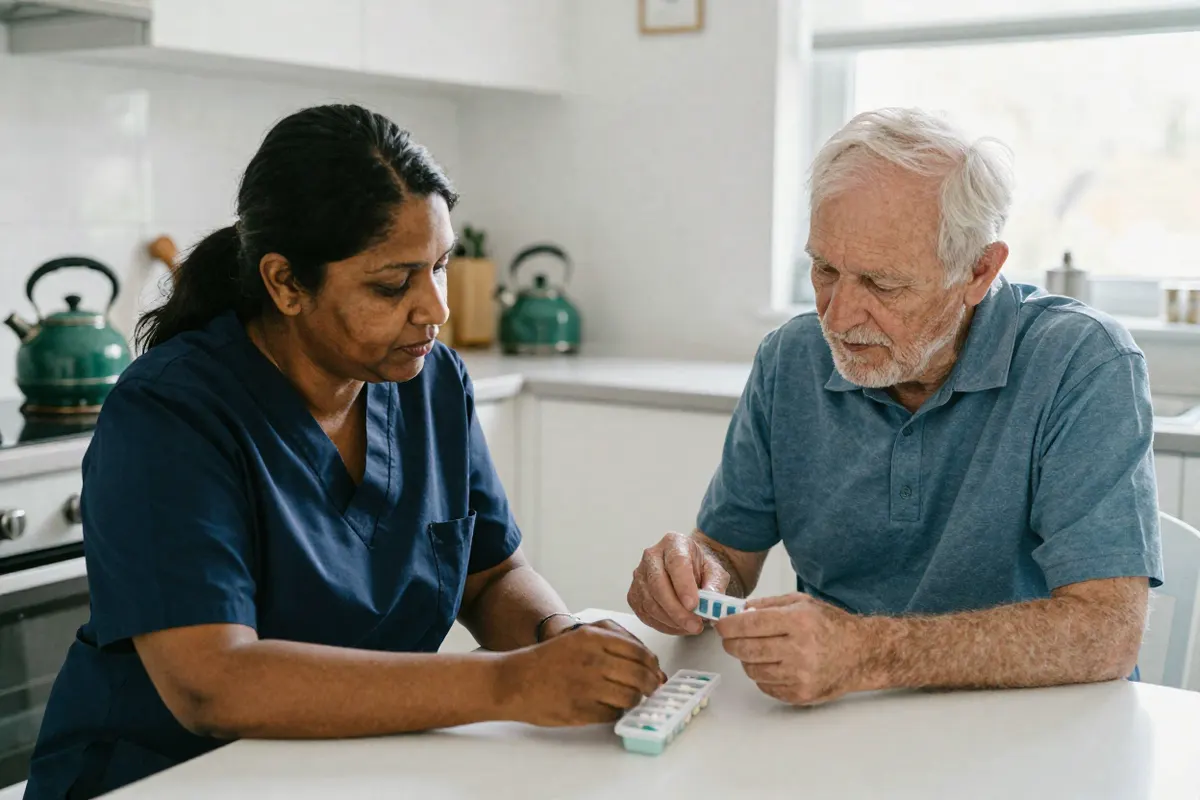
You arrive at 8 a.m. at the home of a man with Parkinson's disease, help him shower with a shower chair and grab bars, and make his breakfast. You remind him to take his morning pills from the organizer his nurse filled, note that his feet look more swollen than usual, and call the agency nurse before you leave.
Spotting a change
A client with dementia who usually chats over lunch is quiet, flushed and confused. You check her temperature as you were trained, write down what you see and call the agency right away. The nurse arranges a same-day visit, and the client turns out to have an infection that was caught early.
A shift in a group home
As a direct support professional, you help three adults with developmental disabilities get ready for their day programs, cook dinner with them that evening and coach one resident through paying for groceries on his own. You record medications given, activities and anything unusual in the house log.
Who does well in this job
Caregiving suits patient, dependable people who like helping others one on one and are comfortable with personal care such as bathing and toileting. Many caregivers start with experience caring for a parent or grandparent, and others come from retail, food service or childcare looking for steadier, more meaningful work. It is one of the few healthcare jobs you can start without a degree, and many agencies train new hires. It is also a common first step toward becoming a nursing assistant, LPN or registered nurse.
You will likely enjoy it if
- You are patient and calm with people who are slow, forgetful, frustrated or in pain
- You are reliable, because a client may be alone and waiting if you are late
- You are comfortable with personal care and working alone in someone's home
- You want a flexible schedule, or a quick start in healthcare while you plan a next step
What you need
- Usually a high school diploma or equivalent, though some jobs do not require it
- A criminal background check, and often a drug screen and a TB test
- The training your state requires for your role, which ranges from none to a state-approved course and exam
- For home health aides at Medicare-certified agencies, a federal training program or competency evaluation; many jobs also want CPR and first aid, a driver's license and a reliable car
Skills that help
Your path into the job
- 1Look up your state's training rules for personal care aides, home health aides and direct support professionals, since they differ a lot
- 2Get CPR and first aid certified, and make sure your driver's license and car insurance are current if you will drive to clients
- 3Apply to home care agencies, home health agencies, hospices, assisted living communities and group homes, many of which hire and train people without experience
- 4Complete the employer's orientation and any state-required training, and for home health aide jobs the 75-hour program and competency evaluation
- 5Shadow an experienced caregiver on your first visits, then start with a small, steady schedule of clients
- 6Keep your certificates organized and ask about paid training toward CNA certification if you want to move up
Common misconceptions
Myth: Caregiving is just keeping someone company.
Reality: Companionship matters, but most visits include hands-on personal care: bathing, toileting, transfers, meals and housekeeping. Caregivers are also often the first to notice a health problem, so watching and reporting is a real part of the job.
Myth: You need a nursing certificate to work as a caregiver.
Reality: Many personal care aide and home care jobs need only the employer's or the state's short training, and some states set no training rules at all. Home health aides at Medicare-certified agencies, and caregivers in some states, do need formal training and a competency test.
Myth: Home health aides and nursing assistants are the same job.
Reality: Both give personal care, but home health aides work in clients' homes, usually alone, while nursing assistants (CNAs) work in nursing homes and hospitals and must pass their state's nurse aide exam. Some aides hold both credentials, which widens their options.
What it pays
Open caregivers jobs that post a rate typically pay $16–$25/hr today, with a live median of $18 an hour across the 37,475 open jobs that state one.
The complete guide
Everything about caregivers jobs
Written by CareJobs.Now
CareJobs.Now reads every job and the pay it states from the employer's own job board each night, and takes a job down once its employer does.
How to become a caregiver or home health aide in 2026: the work, the training, the state rules and the first job
The Bureau of Labor Statistics projects about 760,500 job openings a year for home health and personal care aides between 2025 and 2035 - BLS. Behind that number are millions of older adults and people with disabilities who want to stay in their own homes, including an estimated 7.4 million Americans age 65 and older living with Alzheimer's disease in 2026 - Alzheimer's Association. Someone has to help them bathe, dress, eat, take their medications on time and get through the day safely.
That someone is a caregiver, and it is one of the fastest ways into healthcare. Many employers hire people without experience and train them, and in some states you can start within days. But the job is often misunderstood. It is not just keeping someone company, it is not the same as being a nursing assistant, and the training rules change completely from one state to the next. Pay is low in many places, the work is physical and emotional, and turnover is high, so it pays to go in knowing how the job works.
This guide is for anyone thinking about becoming a caregiver, home health aide, hospice aide or direct support professional. It covers what each job really is, what a day looks like, the training routes and the federal 75-hour standard, the state rules with a state-by-state table, how to land the first job, where the career leads, and the hard parts. If you mainly want pay by state and the rules on overtime and travel time, the companion guide on caregiver jobs and pay covers that in depth.
Contents
- What caregiving jobs really are
- A caregiver's day, hour by hour
- Training paths: agency training, aide programs, CNA and disability support
- State rules, certification and the federal 75-hour standard
- Getting your first caregiver job
- The career ladder and what each step takes
- The hard parts and how people handle them
- Outlook and how to decide
1. What caregiving jobs really are
Caregivers help people who need support with everyday life. The help is practical: bathing, dressing, using the toilet, getting in and out of bed, cooking, cleaning, laundry, shopping, getting to appointments and keeping company. Home health aides do the same work and, under a nurse's supervision, may also check vital signs, help with simple exercises and medications, and keep records, while personal care aides provide nonmedical services such as companionship, cleaning, cooking and driving - BLS.
The clients vary. Many are older adults with frailty, dementia, Parkinson's disease, heart failure or recovery from a fall or surgery. Others are younger adults with physical disabilities, people with intellectual and developmental disabilities, children with complex medical needs, or people near the end of life in hospice. The common thread is that caregivers make it possible for people to live as independently as they can, usually at home.
The different caregiving jobs
Job titles in this field overlap, and employers use them loosely. The table sorts out the main ones by where people work, how they are trained and who supervises them.
| Job | Usual setting | Typical training | Supervision | Core work |
|---|---|---|---|---|
| Personal care aide or home care worker | Clients' homes | Employer training; state hours vary from none to 100 or more | Agency or the client | Personal care, meals, housekeeping, errands, company |
| Home health aide | Homes, through Medicare-certified agencies | At least 75 hours or a competency evaluation (federal rule) | Registered nurse | Personal care plus vital signs and simple care tasks |
| Hospice aide | Homes, nursing homes, hospice houses | Same 75-hour standard, or a state nurse aide program | Registered nurse | Comfort care at the end of life |
| Direct support professional (DSP) | Group homes, day programs, community | Employer and state training | Program staff | Daily living skills and community life for people with disabilities |
| Assisted living or memory care caregiver | Senior living communities | Employer and state training | Nurse or manager | Personal care for several residents per shift |
| Live-in caregiver | One client's home | Varies | Agency or family | Round-the-clock help, with sleep and breaks |
Sources: training rules from 42 CFR 484.80 (home health aides), 42 CFR 418.76 (hospice aides) and PHI (personal care aide training by state).
The key split is between home care and home health. Home care is nonmedical help, often paid for by the client or by Medicaid, and its training rules are set by states. Home health is skilled care ordered by a doctor and usually paid for by Medicare, and its aides must meet federal training and supervision rules. Hospice sits next to home health and follows similar federal rules.
How it differs from a nursing assistant
Caregivers are often confused with certified nursing assistants (CNAs). The work overlaps (both give hands-on personal care), but the setting and credential differ. CNAs mostly work in nursing homes and hospitals, alongside nurses, and they often need to complete a state-approved program and pass their state's competency exam - BLS. Home caregivers usually work alone in a client's home, which means more independence and more responsibility for noticing problems.
Many caregivers eventually get CNA certification because it widens their options and raises pay, and the guide to becoming a CNA or patient care tech covers that route. If you are drawn to supporting people with mental illness or behavioral needs, technician roles in mental health are another neighboring path.
Where the work happens
Most caregivers work in or through home-based services. Individual and family services employ 51% of home health and personal care aides, home health care services 23%, residential facilities for people with intellectual and developmental disabilities 6%, and continuing care and assisted living communities another 6% - BLS. Home care gives you one-on-one time and flexible hours; facilities give you coworkers, a building and usually steadier full-time schedules.
2. A caregiver's day, hour by hour
No two caregiving days are the same, so the days below are composites: plausible, not any one person's. They show the rhythm of home care and of a group home shift.
A home care aide with three clients
7:30 a.m. First client. You let yourself in with the lockbox code and greet Mr. A, who is 84 and has Parkinson's disease. You help him out of bed with a gait belt, walk beside him to the bathroom and help him shower on a shower chair. You help him dress, make oatmeal and remind him to take his morning pills from the weekly organizer his nurse filled. His ankles look more swollen than last week, so you note it and call the agency nurse before you leave.
10:30 a.m. Travel. You drive fifteen minutes to the next client. That drive between clients counts as paid work time under federal rules - 29 CFR 785.38, and many agencies also reimburse mileage.
11:00 a.m. Second client. Mrs. B has dementia and lives with her daughter, who works days. You make lunch together, which keeps her engaged, do a load of laundry and take a short walk around the block. She asks the same question many times; you answer calmly each time. When she becomes upset in the afternoon, you redirect her to a photo album she loves.
2:30 p.m. Errands. For your third client, a younger woman who uses a wheelchair after a spinal cord injury, you pick up a prescription and groceries, then help her with a transfer to her recliner using the techniques the agency trained you in. You prepare dinner so it is ready to heat later.
5:00 p.m. Notes. Before you leave each home you write a short visit note on the agency's app: tasks done, what the client ate, anything unusual. Those notes are how the nurse, the family and the next caregiver know what happened.
A direct support professional in a group home
3:00 p.m. to 11:00 p.m. You arrive as three adults with developmental disabilities return from their day programs. You help one resident with a snack and his evening medications, which you have been trained to give under your state's rules, and record them in the medication log. You cook dinner with the residents, coaching one through measuring ingredients as part of his goal of cooking on his own. After dinner you drive two residents to a bowling league, then help everyone get ready for bed. You write notes on each person's goals and anything unusual before handing off to the overnight staff.
An overnight or live-in shift
Some clients need someone present around the clock. An overnight caregiver might help a client to the bathroom twice during the night, turn a bedbound client every few hours to prevent pressure sores, and be there if the client falls or gets confused. Live-in caregivers stay in the home for several days in a row, with time for sleep and breaks. The rules for paying overnight and live-in work are complicated, and the caregiver pay guide explains them.
3. Training paths: agency training, aide programs, CNA and disability support
There are four main ways to train as a caregiver, and the right one depends on your state and the job you want. The typical entry requirement is a high school diploma or equivalent, though some positions do not require it, and training may happen on the job or through programs at community colleges and vocational schools - BLS.
- Employer training: a home care agency, senior living community or disability provider hires you and trains you, often paid.
- A home health aide program: at least 75 hours, needed for Medicare-certified home health and hospice agencies.
- A CNA program: a state-approved nurse aide course and exam, which opens nursing homes and hospitals too.
- State-specific credentials: such as Washington's home care aide certification or a state DSP training program.
For many people, employer training is the right first step, because it is free and leads straight to a job. The home health aide and CNA routes take a few weeks and sometimes cost money, but they open more employers and higher pay. The rest of this section explains what each one involves.
What employer training covers
Agency and facility training typically covers personal hygiene, safe transfers, infection control, basic nutrition and how to measure vital signs - BLS, plus the employer's own policies: how to clock in, write visit notes, report changes and handle emergencies. Many employers also require first aid and CPR certification. Good employers add dementia care, body mechanics and how to protect your own safety in a client's home, and pair you with an experienced caregiver for your first visits.
The federal home health aide standard
If you want to work for a Medicare-certified home health agency, federal rules set the bar. Aides must complete training of at least 75 hours, with at least 16 hours of classroom training before at least 16 hours of supervised practical training, or pass a competency evaluation performed by a registered nurse, and then receive at least 12 hours of in-service training every year - 42 CFR 484.80. Hospice aides must meet the same 75-hour standard, and a state-approved nurse aide program in good standing on the state registry is one of the accepted ways to qualify - 42 CFR 418.76.
Many home health agencies run these programs themselves or partner with local schools. Before you pay for an outside course, ask the agencies you want to work for whether they train new hires and whether they accept the program you are considering.
The CNA route
A CNA certificate is the most portable credential at this level. Federal rules require nurse aide training programs to include at least 75 clock hours, including at least 16 hours of supervised practical training and at least 16 hours of training before any direct contact with a resident - 42 CFR 483.152. Many states require more. After the course, you pass your state's competency exam and are listed on the state registry.
The trade-off is time and sometimes cost, but the payoff is real: nursing assistants earned a median of $42,260 in May 2025 - BLS, against $35,800 for home health and personal care aides - BLS. Nursing homes often pay for CNA training for new hires who commit to working for them, so ask.
Direct support professional training
Direct support professionals are trained mainly by their employers under state rules for disability services. Training usually covers supporting people's choices and rights, positive behavior support, medication administration where the state allows it, recognizing abuse and neglect, and emergency procedures. Because DSP rules are set by each state's disability services agency, ask employers what training they provide and whether it leads to any state or national credential.
How to choose a program
If you pay for training, make sure it is the training your state and your target employers actually require. A " caregiver certificate" from an online course may mean nothing in a state that requires a specific approved program, or may be unnecessary in a state that requires no training at all. Ask three questions before you enroll: is the program approved by the state for the role you want, will local employers accept it, and does any employer offer the same training for free? The answer to the third is often yes.
4. State rules, certification and the federal 75-hour standard
Outside Medicare-certified home health and hospice, caregiver training is regulated by states, and the rules differ enormously. In a review of 2024 to 2025 state policy, PHI found that 7 states do not regulate personal care aide training at all, 26 states and Washington, D.C. require a minimum number of training hours, and 15 of those states plus D.C. require 40 hours or more - PHI. PHI also found that 34 states and D.C. require a competency assessment, 18 states and D.C. offer transferable credentials, and 14 states and D.C. keep a centralized registry.
| State | Role | Required training hours |
|---|---|---|
| Texas | Personal care aide | No training requirement |
| Minnesota | Personal care assistant | No hours specified |
| Pennsylvania | Direct care worker, consumer-directed programs | 8 hours across the first four months |
| California | Home care aide affiliated with an agency | 10 hours |
| Illinois | Home care aide | 24 hours |
| Missouri | Personal care aide | 12 hours |
| Florida | Home health aide | 40 hours |
| New York | Personal care aide | 40 hours, within 90 days of starting training |
| Massachusetts | Personal care homemaker | 60 hours |
| Washington | Home care aide | 75 hours |
| Hawaii | Personal care aide | 100 hours, including 70 supervised practical |
| District of Columbia | Home health aide | 125 hours |
Source: PHI, personal care aide training requirements by state.
The same state can have several sets of rules for different programs. Illinois, for example, sets 10 hours for home services workers, 24 for home care aides and 12 for homemakers, and Massachusetts sets 60 hours for personal care homemakers but about 4 for consumer-directed personal care attendants - PHI. That is why the most reliable answer for your situation comes from the employer and the state agency that funds the program.
Washington: an example of a full certification
Washington has one of the most complete systems. Home care aides must complete 75 hours of training through a program approved by the state Department of Social and Health Services and pass the home care aide certification exam - Washington State Department of Health. Training must be finished within 120 days of hire, and under emergency rules aides may work for up to 365 days from their hire date while they complete certification, an extension that ends December 31, 2027, when the limit returns to 200 days - Washington State Department of Health.
Supervision in home health and hospice
Federal rules also set how closely aides are supervised. In home health, a registered nurse or other professional must assess the aide's care at least every 14 days for patients receiving skilled care, and a registered nurse must make an onsite, in-person visit at least every 60 days for patients who receive only aide services - 42 CFR 484.80. In hospice, a registered nurse must visit the patient's home at least every 14 days to assess the aide's care - 42 CFR 418.76. For a new caregiver that supervision is a benefit: it means a nurse you can call.
Background checks and health requirements
Almost every caregiving job requires a criminal background check, and many add fingerprinting, a drug screen, a TB test and proof of vaccinations. Jobs that involve driving clients require a valid driver's license, a clean driving record and car insurance. Some states keep registries of aides or of people barred from care work, and employers check them. If you have an old conviction, ask the employer or your state agency how it is treated before you give up: rules on which offenses disqualify you, and for how long, vary by state.
5. Getting your first caregiver job
Caregiving has one of the lowest barriers to entry in healthcare, and employers hire constantly. What they screen for is less about credentials than character: reliability, honesty, patience and the ability to work alone. A client who depends on you to get out of bed cannot wait if you are late, and agencies know it.
Right now 349 open caregiver jobs on this site mention that no experience is needed, and 53,260 caregiver jobs are open in total. Our state pages show where they are.
Where new caregivers get hired
Home care and home health agencies are the biggest employers of new caregivers. On this site they include BAYADA Home Health Care, Amedisys, Elara Caring, VitalCaring and 21st Century Home Health Services, and MedCare Pediatric Group for children with medical needs. Hospice providers such as Compassus, Moments Hospice and Arc Hospice & Palliative Care hire hospice aides; right now 545 open caregiver jobs mention hospice.
Senior living companies such as Brookdale Senior Living, Silverado and Spring Oak Senior Living hire caregivers for assisted living and memory care, and disability providers such as Dungarvin hire direct support professionals. Our employer directory lists every employer whose own job board feeds this site. If you prefer coworkers and a steady schedule, start in a facility; if you want flexibility and one-on-one work, start with a home care agency.
Resume and interview points
If you have cared for a parent, grandparent or child with a disability, put it on your resume. Describe it like a job: who you cared for, for how long, and what you did (bathing, transfers, medications, appointments, dementia care). Add any related work, such as childcare, food service or cleaning, and stress reliability: showing up on time, every time.
Caregiver interviews often include scenarios. You might be asked what you would do if a client refuses to bathe, if you find a client on the floor, or if a family member asks you to do something outside the care plan. Good answers put safety first, respect the client's choices and dignity, and involve the agency or nurse when something is outside your role. Our healthcare job interview guide covers common questions.
Your first month
The first weeks set the pattern for the rest of the job. Most employers start new caregivers with orientation and shadowing, then a small number of steady clients. Use that time to learn each client's routine in detail: how they like their coffee, which side they get out of bed, what upsets them and what calms them. Write it down if the agency allows it, because consistency is what makes clients trust you.
Learn the reporting rules early too. Know exactly who to call, and how fast, when a client falls, refuses medications, seems newly confused, has a new skin sore or stops eating, and when to call 911 first. Caregivers are often the first to see that something is wrong, and catching it early can keep a client out of the hospital. Finally, protect your schedule: tell the scheduler what hours and areas you can really cover, so you are not set up to fail with back-to-back visits across town.
Questions to ask before you accept
The answers to a few questions tell you a lot about an employer. Ask how many hours you can count on each week, whether drive time between clients is paid and mileage reimbursed, what happens when a client cancels, how scheduling works for evenings and weekends, and who you call when something goes wrong during a visit. Ask whether the employer pays for training toward home health aide or CNA certification. And confirm that you will be an employee, with taxes withheld, so overtime and other protections apply.
6. The career ladder and what each step takes
Caregiving is a good job in its own right, and for many people it is also the first rung of a care career. The skills you build (personal care, transfers, noticing changes, working with families) are the base for nursing assistant work and nursing.
Each step takes something different and pays differently. The table shows the May 2025 median pay and typical training for the main rungs.
| Step | Median pay, May 2025 | Typical training |
|---|---|---|
| Home health or personal care aide | $35,800 | None to 75 hours, by state and role - BLS |
| Nursing assistant (CNA) | $42,260 | State-approved program of at least 75 hours and an exam - BLS |
| Licensed practical nurse | $64,400 | About a one-year program and a licensing exam - BLS |
| Registered nurse | $97,550 | A BSN, an associate degree or a diploma program, then a licensing exam - BLS |
The jump from caregiver to CNA is short and worth about $6,460 a year at the median. The jump to LPN takes about a year of school and nearly doubles caregiver pay. The RN step takes longer: BLS notes that both BSN and associate degree programs typically take four years to complete, and diploma programs two to three years - BLS. Many nurses started as caregivers or CNAs and worked while they studied; the nursing guide covers that path.
Not everyone wants to become a nurse. Experienced caregivers also move into lead caregiver, scheduler, trainer and care coordinator roles at agencies, and direct support professionals move into house manager and program roles in disability services. Those roles reward reliability, judgment and the ability to teach others. The caregiver pay guide shows what each setting and state pays, and right now open caregiver jobs that state pay typically offer $16 to $25 an hour.
7. The hard parts and how people handle them
Caregiving is meaningful work, and many caregivers say the relationships with their clients are the best part of the job. It is also hard in specific ways, and the people who last know what they are getting into.
The physical work
Helping people stand, transfer, bathe and turn in bed is heavy work. Caregivers must use proper lifting techniques to reduce the risk of back injury, may face difficult or violent behavior from some clients, and are exposed to minor infections and communicable diseases - BLS. Among nursing assistants, who do similar lifting in facilities, OSHA reports a 2017 rate of 166.3 musculoskeletal injury cases with days away from work per 10,000 workers, more than five times the rate for all workers, and it links these injuries largely to repeated manual patient handling - OSHA.
How people handle it: they use gait belts, transfer boards and mechanical lifts where they are available, never try to catch a falling client with their back, ask for a second person or equipment when a client is too heavy, and report any injury right away. In a client's home you often have less equipment than in a facility, so speak up to the agency when a client's needs outgrow what one person can safely do.
Working alone
Home caregivers work without coworkers. You may walk into a home that is cluttered or unsafe, meet aggressive pets or difficult family members, or face an emergency with no one else there. Good agencies train you on what to do: how to call 911, when to leave a home that feels unsafe, how to report concerns, and who to call at any hour. Keep your phone charged, know the address of every client by heart, and trust your instincts about safety.
The emotional load
Caregivers form close bonds with clients and their families, and then lose them: clients move to nursing homes, go into the hospital or die. Dementia care brings its own strain, from repeated questions to anger, wandering and sundowning. Families under stress sometimes take it out on the caregiver. People who last in the job learn to set boundaries, lean on their supervisor and coworkers, and take time to grieve when a client dies. Many hospice teams offer support for staff, and it is worth using.
Low pay and high turnover
The hardest part for many caregivers is money. PHI finds that 34% of direct care workers live in or near poverty and 45% rely on public assistance programs - PHI, and turnover is estimated at 79% a year for home care workers - Alzheimer's Association. High turnover means agencies are always hiring, but it also means unstable schedules and coworkers who come and go.
The answer most caregivers find is to be deliberate: choose employers that guarantee hours and pay for drive time, pick up premium weekend or overnight shifts if you can, and use the job as a paid way to build toward a credential. Our per diem and PRN guide explains how picking up extra shifts with a second employer works, and the caregiver pay guide shows which states pay the most.
8. Outlook and how to decide
Demand for caregivers is enormous and growing. BLS projects home health and personal care aide jobs to grow 18.1% from 2025 to 2035, from 4,677,100 to 5,524,400, with about 760,500 openings a year - BLS. PHI estimates that 9.6 million direct care jobs will need to be filled over the same decade - PHI, and the Alzheimer's Association expects nearly 800,000 additional direct care workers to be needed between 2024 and 2034 - Alzheimer's Association.
That demand means you can find caregiving work almost anywhere, and that good caregivers have bargaining power on hours and schedules. It does not make every job a good one. Choose employers by how they treat caregivers: steady hours, paid drive time, training and real support when something goes wrong. For a wider view of where healthcare jobs are growing, see the fastest-growing healthcare jobs in 2026.
A decision framework
Caregiving is probably a good fit if most of these are true:
- You are patient: you can stay kind with someone who is slow, confused or frustrated.
- You are reliable: you show up on time, every time, because someone is waiting.
- You are comfortable with personal care: bathing, toileting and dressing another adult do not put you off.
- You like independence: you are fine working alone and making small decisions on your own.
If you want coworkers and a fixed schedule, start in assisted living, memory care or a group home rather than home care. If you want more pay soon, plan to add CNA certification within your first year. If you want a long-term career in nursing, treat caregiving as paid experience and start the prerequisites for an LPN or RN program while you work.
How to start this month
You can be working within weeks. Look up your state's training rules for the role you want (your state's health or social services department, or the PHI state table above). Get CPR and first aid certified. Make sure your driver's license and car insurance are current if you will drive to clients. Then apply to two or three home care agencies, a home health agency and a senior living community near you, and ask each one about paid training, guaranteed hours and paid drive time. Browse the caregiver jobs on this site to see who is hiring in your area, and compare employers in the employer directory.
Caregiving asks a lot of your body and your heart, and in many places it does not pay what it is worth. But it is one of the few jobs where you can start helping people within weeks, it opens the door to nursing and other care careers, and the people you care for will remember you.
This guide reflects caregiver training rules and state requirements as of October 2026. Rules, fees and pay change: check the linked source before you rely on a figure.
Frequently asked questions
Do I need a certificate to be a caregiver?
It depends on your state and your role. In a 2024 to 2025 review, PHI found that 7 states do not regulate personal care aide training at all, while 26 states and Washington, D.C. set a minimum number of hours, ranging from about 4 hours for some Massachusetts roles to 75 hours in Washington and 125 hours for D.C. home health aides - PHI. Check your state's health or social services department before you pay for a course.
What training does a home health aide need?
Aides at Medicare-certified home health agencies must complete training of at least 75 hours, including at least 16 hours of supervised practical training, or pass a competency evaluation, and then receive at least 12 hours of in-service training every year - 42 CFR 484.80. Hospice aides follow the same 75-hour standard - 42 CFR 418.76.
How much do caregivers make?
Home health and personal care aides earned a median of $17.21 an hour ($35,800 a year) in May 2025 - BLS. Pay varies widely by state, from a median of $47,730 a year in Washington to under $25,000 in several Southern states - Wagedex, from BLS OEWS. See caregiver jobs and pay for more.
Do caregivers get paid for travel time and overtime?
Travel from one client's home to another during the workday counts as hours worked under federal rules - 29 CFR 785.38. Under a 2013 Labor Department rule, home care agencies cannot use the companionship exemption to avoid minimum wage and overtime, but in July 2025 the department proposed returning to its 1975 rules - US Department of Labor, so check the current status and your state's own law.
Is there demand for caregivers?
Huge demand. BLS projects home health and personal care aide jobs to grow 18% from 2025 to 2035, with about 760,500 openings a year - BLS. Many agencies hire people without experience and train them, so you can start quickly.
Related kinds of job
Nursing Assistants & Patient Care Techs
Hands-on caregivers who help patients bathe, eat, move and stay safe, and tell the nurse when things change.
Registered Nurses & LPNs
Licensed nurses who assess, treat, give medications and watch over patients around the clock.
Mental Health & Social Work
Help people through mental illness, addiction and crisis, from the psych unit floor to the therapy room.