Diagnose, treat and counsel
How to Become a PT, OT, SLP or Respiratory Therapist
Licensed therapists who help people move, breathe, speak and swallow again after illness or injury.
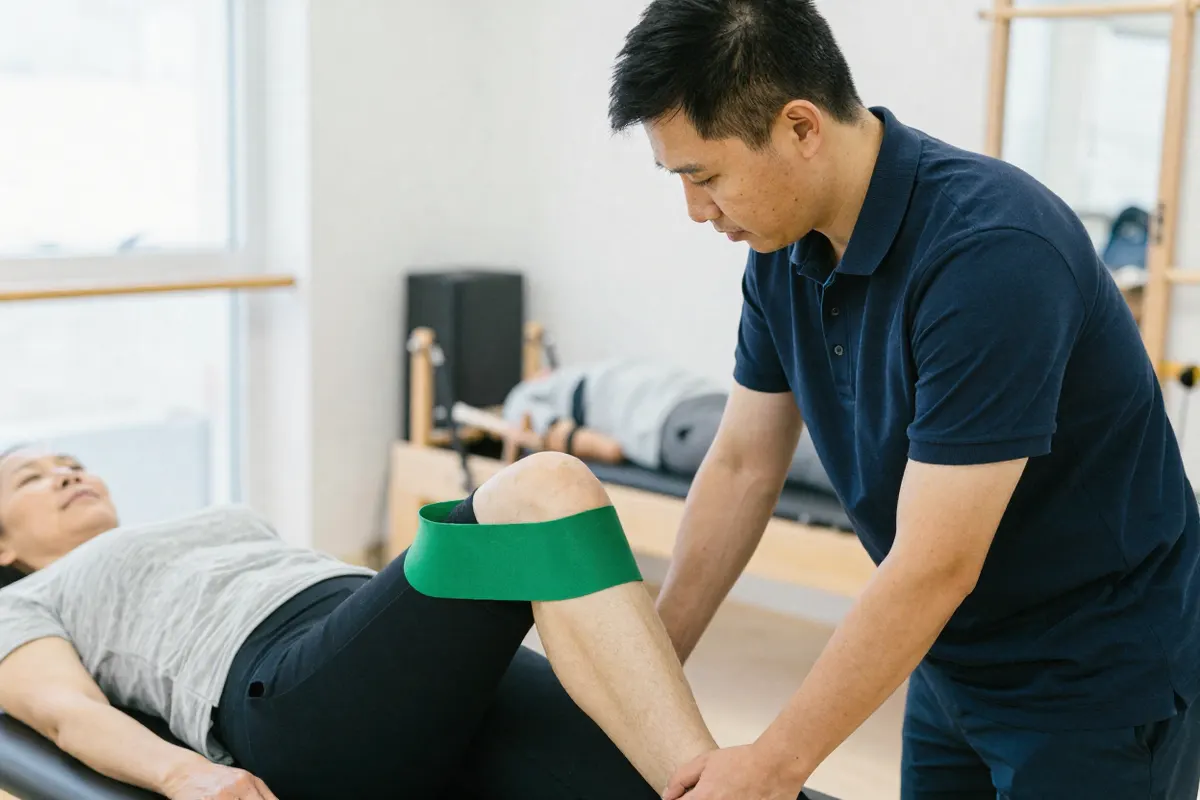
What the job is
Therapy and rehab jobs help people recover what an illness, injury, surgery or disability took away: walking, using their hands, speaking, swallowing or breathing. Physical therapists focus on movement and strength, occupational therapists on the everyday tasks of life such as dressing, cooking and working, speech-language pathologists on communication and swallowing, and respiratory therapists on breathing, from asthma care to ventilators in the ICU. Assistants (PTAs and COTAs) carry out treatment plans under a therapist, and aides set up equipment and help in the gym. Every therapist and assistant needs a state license.
A typical shift
- Evaluate a new patient's strength, movement, thinking, speech, swallowing or breathing and set goals with them
- Run treatment sessions: exercises, gait training, hand therapy, speech drills, airway clearance or ventilator checks
- Teach patients and families home exercises, safe transfers, adaptive equipment or inhaler technique
- Measure progress at each visit and adjust the plan as the patient improves or struggles
- Write evaluations, daily notes and progress reports that insurers and the care team rely on
- Work with nurses, doctors and other therapists on discharge plans and safety
What a shift looks like
Walking after a knee replacement
On the morning after surgery, a hospital physical therapist helps a patient stand for the first time, checks her pain and blood pressure, and walks her to the doorway with a walker. Before discharge the therapist teaches her the stairs and a home exercise plan.
Getting dressed again after a stroke
An occupational therapist in an inpatient rehab unit works with a man who has weakness on one side. They practice putting on a shirt one-handed and using a reacher, and the therapist orders a shower chair and grab bars for his home.
A ventilator check in the ICU
A respiratory therapist on night shift checks each ventilated patient's settings, breath sounds and blood gas results, suctions an airway and adjusts oxygen with the doctor's orders. When a patient is ready, the therapist runs a breathing trial to see if the tube can come out.
Who does well in this job
These jobs suit people who like science and anatomy, enjoy coaching and encouraging others, and are happy to see progress in small steps over weeks. Many therapists played sports, cared for a family member through rehab, or worked as an aide or tech before choosing a field. Physical and occupational therapy reward people who are physically active and like hands-on work, speech-language pathology suits people fascinated by language and how the brain works, and respiratory therapy suits people who want fast-paced hospital work with machines and emergencies. Assistant roles fit people who want patient care without a graduate degree.
You will likely enjoy it if
- You enjoy motivating people through hard, repetitive work toward a goal
- You like anatomy, physiology or language and want to use it every day
- You are comfortable with physical work, such as helping patients stand and walk
- You want a licensed career with strong demand and room to specialize
What you need
- Physical therapists: a Doctor of Physical Therapy (DPT) from an accredited program, the NPTE exam and a state license
- Occupational therapists and speech-language pathologists: an accredited master's or doctorate, a national exam (NBCOT or Praxis) and a state license; SLPs also complete a clinical fellowship
- Assistants (PTA, COTA) and respiratory therapists: an accredited associate degree, a national exam and a state license (respiratory therapists are licensed in every state except Alaska)
- CPR or basic life support certification, a background check and current immunizations for clinical placements
Skills that help
Your path into the job
- 1Pick a field by shadowing: spend a day with a PT, an OT, an SLP and a respiratory therapist, since many programs require observation hours anyway
- 2Choose your level: an associate degree for PTA, COTA or respiratory therapy, or a bachelor's plus a graduate program for PT, OT or SLP
- 3Take the prerequisites (anatomy, physiology, chemistry, physics, statistics) and apply to accredited programs (CAPTE, ACOTE, CAA or CoARC), comparing exam pass rates and costs
- 4Complete the program and its full-time clinical rotations, asking for placements in the setting where you want to work
- 5Pass the national exam for your field, apply for your state license and, for SLPs, start a paid clinical fellowship
- 6Apply for new-graduate jobs in hospitals, outpatient clinics, schools, rehab centers or home health, and ask about mentoring for your first year
Common misconceptions
Myth: Physical therapy is just exercise and massage.
Reality: Physical therapists are licensed providers with doctoral training who examine patients, diagnose movement problems and design treatment, often without a physician referral for an initial period, depending on the state. Exercise is a tool, not the whole job.
Myth: Occupational therapy is about finding people jobs.
Reality: The occupation in occupational therapy means any meaningful daily activity: dressing, cooking, writing, driving, playing or working. OTs help people do those things again after injury or illness, or for the first time when a child has a disability.
Myth: Speech therapists only work with children who lisp.
Reality: Speech-language pathologists treat language, voice, stuttering and thinking problems, and in hospitals and nursing homes much of the work is swallowing. Many work with adults after strokes, brain injuries or head and neck cancer.
What it pays
Open therapy & rehab jobs that post a rate typically pay $35–$70/hr today, with a live median of $45 an hour across the Unavailable open jobs that state one.
The complete guide
Everything about therapy & rehab jobs
Written by CareJobs.Now
CareJobs.Now reads every job and the pay it states from the employer's own job board each night, and takes a job down once its employer does.
How to become a physical, occupational, speech or respiratory therapist in 2026: the work, the degrees, the exams and the first job
Physical therapists held about 283,700 jobs in 2025, and the Bureau of Labor Statistics projects the field to grow 12% by 2035 - BLS. The assistants who work beside them are growing even faster, and occupational therapy, speech-language pathology and respiratory therapy are all projected to grow much faster than the average job. Together these fields form one of the largest groups of licensed careers in healthcare outside nursing and medicine.
They are also easy to mix up. Many people think physical therapy is mostly exercise, that occupational therapy is about finding work, that speech therapy is only for children, or that respiratory therapists just hand out inhalers. In reality each is a distinct licensed profession with its own degree, national exam and way of thinking about recovery, and each has an assistant or entry route for people who want to start sooner.
This guide is for anyone deciding whether to go into therapy and rehab, choosing between the fields, or getting ready for a first job. It covers what each job really is, what a day looks like, the degrees with their real length and cost, the exams and licenses, how new graduates get hired, the career ladder and the hard parts. If you mainly want pay by job, setting and state, the companion guide on therapy and rehab jobs and pay covers that in depth.
Contents
- What therapy and rehab jobs really are
- Three days in the work, hour by hour
- Training paths: degrees, length, cost and accreditation
- Exams, licenses and certification
- Getting your first therapy job
- The career ladder and what each step takes
- The hard parts and how people handle them
- Outlook and how to decide
1. What therapy and rehab jobs really are
Therapy and rehab jobs help people get back what illness, injury, surgery or disability took from them, or build skills they never had. Each profession owns a different piece of that. Physical therapists treat movement: strength, balance, walking and pain. Occupational therapists treat the activities of daily life, such as dressing, bathing, cooking, writing and working, often including hand function and thinking skills. Speech-language pathologists treat communication and swallowing, from a toddler's first words to an adult relearning to swallow after a stroke. Respiratory therapists treat breathing, from asthma and COPD to ventilators in the ICU.
Below the therapists sit two more levels. Physical therapist assistants (PTAs) and occupational therapy assistants (COTAs) carry out treatment plans written by a therapist, with a two-year degree and their own license. Aides set up equipment, clean, transport patients and help in the gym; PT aides are hired with a high school diploma and trained on the job for about a week to a month - BLS. Athletic trainers, exercise physiologists and recreational therapists also appear in this category of jobs, and many of the same ideas apply to them.
| Job | Typical degree | Program accreditor | National exam | Core focus |
|---|---|---|---|---|
| Physical therapist | Doctor of Physical Therapy (DPT) | CAPTE | NPTE (FSBPT) | Movement, strength, balance, pain |
| PT assistant | Associate degree | CAPTE | NPTE for PTAs | Carrying out the PT's plan |
| Occupational therapist | Master's or doctorate | ACOTE | NBCOT exam (OTR) | Daily activities, hands, thinking |
| OT assistant | Associate degree | ACOTE | NBCOT exam (COTA) | Carrying out the OT's plan |
| Speech-language pathologist | Master's degree | CAA (ASHA) | Praxis, then a clinical fellowship | Speech, language, voice, swallowing |
| Respiratory therapist | Associate degree (some bachelor's) | CoARC | NBRC exams | Breathing, airways, ventilators |
| Rehab aide | High school diploma | None | None | Setup, cleaning, helping in the gym |
The table shows the main structural difference: physical therapy now requires a doctorate, occupational therapy and speech-language pathology a master's, and respiratory therapy and the assistant roles an associate degree. That shapes everything else, from how long it takes to start to how much debt you carry.
How the fields overlap and differ
The overlaps are real. After a stroke, a patient may see a PT to walk again, an OT to dress and cook again and an SLP to speak and swallow again, often on the same day, and the three plan together. The difference is in what each one measures and treats. A PT asks "can you get to the bathroom safely?", an OT asks "can you use the bathroom on your own?", and an SLP asks "can you tell someone you need the bathroom, and can you swallow your pills?"
Respiratory therapy is the odd one out: it is much more hospital-based and closer to critical care. Respiratory therapists run ventilators, give breathing treatments, draw and analyze blood gases and respond to emergencies, and 80% of them work in hospitals - BLS. If you like the idea of hands-on care but want a hospital floor rather than a clinic gym, compare it with nursing in the guide to becoming a nurse.
Where the work happens
Physical therapists work mostly in outpatient therapy offices ( 36%) and hospitals ( 26%), with smaller shares in home health and nursing facilities - BLS. Occupational therapists are spread across therapy offices ( 28%), hospitals ( 26%) and schools ( 13%) - BLS. Speech-language pathologists work most often in schools: educational services employ 39% of them - BLS.
The setting changes the job more than the title does. An outpatient PT treats mostly sports injuries, back pain and post-surgery patients on a tight schedule. A nursing home OT works with frail older adults on safety and independence. A school SLP manages a caseload of children with legal education plans. A home health therapist drives between patients' homes and plans around their kitchens and stairs. When you choose clinical rotations, try more than one setting.
2. Three days in the work, hour by hour
No two clinics or hospitals run the same way, so the days below are composites: plausible, not any one person's. They show how differently these jobs feel from the inside.
An outpatient physical therapist
7:00 a.m. Before the first patient. You review today's schedule (about a dozen patients, two new evaluations) and the notes from each patient's last visit. A PT aide sets up the gym and cleans tables between sessions.
7:30 a.m. to noon. Treatment sessions. A runner with knee pain works on hip strength and landing mechanics. A man six weeks after shoulder surgery gets gentle range of motion and a progressed home program. A woman with low back pain learns how to lift her toddler safely. Between sessions you write short notes and update each plan of care. A PTA treats some of your follow-up patients under your plan and checks in with you when a patient is not progressing.
1:00 p.m. A new evaluation. A 70-year-old woman who has fallen twice gets a full exam: strength, balance tests, walking speed and a look at her medications and home. You set goals with her (getting up from the floor, walking to church) and design a program. Because she gets dizzy turning her head, you test for an inner ear cause before you finish.
4:30 p.m. Wrapping up. You finish notes, call an orthopedic surgeon's office about a patient's progress, and check that authorizations are in place for next week. Physical therapists spend much of the day on their feet, lifting and moving patients - BLS, so by evening you are tired in a physical way.
A respiratory therapist on a hospital night shift
6:45 p.m. Report. You take report from the day shift on your assigned patients: three on ventilators in the ICU, several on high-flow oxygen on the medical floors, and a list of scheduled breathing treatments. Respiratory therapists commonly work nights, weekends and holidays because hospitals are always open - BLS.
8:00 p.m. Rounds. You check each ventilator's settings and alarms, listen to breath sounds, suction secretions and draw an arterial blood gas on a patient whose oxygen is falling. You call the ICU doctor with the results and adjust the settings as ordered.
2:30 a.m. A rapid response. A patient on a medical floor is struggling to breathe. You arrive with the rapid response team, put the patient on noninvasive ventilation and stay with the nurse until he settles or moves to the ICU.
5:30 a.m. Before handoff. You run a spontaneous breathing trial on a patient who has been improving, so the day team can decide whether to remove her breathing tube, then finish charting and give report at 7 a.m.
A school speech-language pathologist
7:45 a.m. to 3:30 p.m. You split your week between two elementary schools. Today you see small groups for articulation and language, run a session with a child who uses a tablet to communicate, and test a kindergartner a teacher is worried about. After school you write evaluation reports and attend an education plan meeting with a family. School-based SLPs may have a two-month summer break and a shorter midwinter break - BLS, which is a big part of the appeal for many.
3. Training paths: degrees, length, cost and accreditation
The degree you need depends on the profession, and the differences in time and cost are large. The cleanest way to compare is to look at the whole path from high school to license.
- Respiratory therapist: an associate degree from an accredited program, about two years; some employers prefer a bachelor's.
- PTA or COTA: an associate degree from an accredited program, typically about two years.
- Speech-language pathologist: a bachelor's, then a master's that usually takes 2 years, then a paid clinical fellowship.
- Occupational therapist: a bachelor's, then a master's (or an entry-level doctorate).
- Physical therapist: a bachelor's with science prerequisites, then a DPT that typically takes 3 years.
The two-year routes get you earning soonest and carry the least debt, and many people use them as a step toward the longer ones. The graduate routes lead to more independence and pay, but they take six to seven years of college in total, and the cost differences between programs are larger than most applicants realize.
Physical therapy: the DPT
A Doctor of Physical Therapy program typically takes 3 years and usually requires a bachelor's degree with prerequisites such as anatomy, chemistry and physics - BLS. There were about 305 accredited DPT programs as of December 2025, and the average program ran 122.4 weeks, including 34.7 weeks of full-time clinical education - CAPTE.
Cost is where the choice of program matters most. For students graduating in 2025, the mean total cost of a DPT program (excluding room and board) was $74,348 at a public school for in-state students and $129,942 at a private school - CAPTE. About two-thirds of programs reported typical DPT program debt for their graduates between $75,000 and $149,999. Since a PT's median salary is about $102,760 - BLS, a $50,000 difference in debt is a real difference in your first decade.
Physical therapist assistants
PTA programs are a much cheaper and shorter path to a licensed therapy job. The typical program is an associate degree of about two years - BLS, and the average CAPTE-accredited program ran 73.1 weeks, including about 16 weeks of full-time clinical education, with a mean total cost of $13,790 at public programs for in-district students and $44,938 at private ones - CAPTE. That is a fraction of the DPT cost, which is why many people start as PTAs.
Occupational therapy and OT assistants
Occupational therapists typically enter with a master's degree in occupational therapy - BLS, and some schools offer an entry-level doctorate (OTD) instead. Both include supervised fieldwork in real settings. Occupational therapy assistants typically complete an associate degree from an accredited program, and some bachelor's programs also exist - BLS. If you are choosing between a master's and a doctorate in OT, ask both programs what the extra year costs and whether employers near you pay more for it.
Speech-language pathology
SLP master's programs usually take two years after a bachelor's - BLS, and many applicants have an undergraduate degree in communication sciences and disorders (others take prerequisite courses first). ASHA certification requires at least 400 clock hours of supervised clinical experience, 25 in guided observation and 375 in direct contact with clients, with at least 325 completed in an accredited graduate program - ASHA. Graduate admissions are competitive, so strong grades and observation hours matter.
Respiratory therapy
Respiratory therapists typically need an associate degree in respiratory therapy from an accredited program, and some employers prefer a bachelor's - BLS. To sit for the national exams you must graduate from a program supported or accredited by the Commission on Accreditation for Respiratory Care (CoARC) - NBRC. Many associate programs are at community colleges, which keeps the cost low, and some hospitals offer tuition help to current employees.
Employer-paid routes
Some people get part of their training paid for. Hospitals and large therapy groups often offer tuition help to aides and assistants who go back to school, sometimes in exchange for a commitment to stay. Respiratory therapy programs at community colleges often partner with local hospitals for clinical rotations, which can turn into job offers. If you already work in healthcare, ask human resources what tuition benefits exist before you enroll, and get any repayment terms in writing.
How to choose a program
Accreditation is the first filter in every field, because without it you cannot sit for the national exam. After that, compare three numbers each program must be able to give you: first-time exam pass rate, graduation rate and employment rate. For context, the mean first-time NPTE pass rate across DPT programs was 86.3% in 2025, the graduation rate 95.4% and the employment rate a year after graduation 99.5% - CAPTE. A program well below those averages should explain why.
Then look at clinical placements and total cost. Ask how rotations are assigned, whether you must relocate for them, and which settings are available, since your final rotation is often how you get your first job offer. Compare the full cost, including fees, travel to rotations and lost earnings, not just tuition. And if you already work in healthcare, ask your employer about tuition help before you apply.
4. Exams, licenses and certification
Every therapist and assistant in this category needs a state license, and each profession has one national exam that states use. The table shows the main exams and what they cost.
| Profession | National exam or credential | Fee | Notes |
|---|---|---|---|
| PT and PTA | NPTE, from FSBPT | $485 exam fee, plus a testing fee and your state's license fee | FSBPT |
| OT and COTA | NBCOT certification exam | $540 online application; $430 for a retake | NBCOT |
| SLP | Praxis in speech-language pathology, then the CCC-SLP | Passing Praxis score 162; CCC application $490 with ASHA membership or $446 without | ASHA, ASHA fees |
| Respiratory therapist | NBRC TMC exam, then the clinical simulation exam for the RRT | $190 TMC (new applicants), $200 clinical simulation | NBRC, NBRC CSE |
Fees are only part of the cost. Budget for a review course or practice exams, your state license application, a background check and, in some states, a separate state law exam - BLS. Many new graduates test within a few months of finishing school, and some employers hire them conditionally while the license is pending.
Preparing for the exam
The national exams test clinical reasoning more than memorized facts, so the best preparation looks like the job: practice questions built around patient cases, timed full-length practice tests, and a review of the content outline each exam publishes. Most candidates study for several weeks to a few months, often while starting work. Build a schedule that ends a week before your test date, so you can rest, and plan for a retake in your budget and your job offer in case you need one. If you have test anxiety or a documented disability, ask the testing body early about accommodations, since approvals take time.
Speech-language pathology: the clinical fellowship
SLPs have an extra step. After the master's and the Praxis, you complete a clinical fellowship of at least 36 weeks and 1,260 hours under a mentor who holds ASHA certification, then apply for the CCC-SLP - ASHA. The fellowship is a paid job, usually your first, so choosing it is like choosing a first job with built-in mentoring. Ask employers whether they provide a certified mentor and how mentoring time is scheduled.
Respiratory therapy: a new exam in 2027
The NBRC credentials are changing. Today, a low cut score on the TMC earns the CRT, and a high cut score makes you eligible for the clinical simulation exam that leads to the RRT - NBRC. From January 2027, a single Respiratory Therapy Examination of 185 multiple-choice items replaces both, costing $360 for new applicants; a low cut score earns the CRT and a high cut score the RRT, and the old clinical simulation exam stays available through December 31, 2027 only for those who pass the TMC at the high cut score before the end of 2026 - NBRC. Some employers require the RRT before hire or within a set time on the job - BLS.
State licenses and compacts
Licensing is done by states, and it differs in the details. All states require physical therapists and occupational therapists to be licensed, and all states require PTAs to be licensed or certified - BLS. Respiratory therapists are licensed in every state except Alaska, where national certification is recommended - BLS. For working in more than one state, interstate compacts are spreading at different speeds.
| Profession | Compact | Status in 2026 |
|---|---|---|
| PT and PTA | PT Compact | 38 jurisdictions issue and accept privileges; California, Florida and New York are not members - PT Compact |
| OT and COTA | OT Licensure Compact | Began issuing privileges in 2026; 11 states issuing as of 9 Nov 2026 - Jackson Therapy Partners |
| SLP | Audiology and Speech-Language Pathology Interstate Compact | 5 states issuing as of 9 Nov 2026, the first in 2026 - Jackson Therapy Partners |
A compact privilege is not a license in the other state, and you must keep your home state license active. If you plan to move, check your new state's board for its own rules, such as a law exam.
Keeping your credentials
Continuing education is typically required to keep a PT license - BLS. ASHA-certified SLPs must earn at least 30 professional development hours every three years, including one hour in ethics - ASHA, and pay annual certification fees of $250 for members or $221 for non-members - ASHA. NBCOT certification renews online for $65 - NBCOT, and many states require continuing education for OT licenses too.
5. Getting your first therapy job
New therapists are in strong demand. Across accredited DPT programs, the mean employment rate a year after graduation was 99.5% in 2025 - CAPTE, and for PTA programs it was 99.1% - CAPTE. The challenge is less getting a job than getting the right first one: a setting where you learn, with mentoring and a workload you can sustain.
Employers screen for a license (or eligibility for a temporary one), a clean background check, CPR or basic life support certification, which some employers require for occupational therapists - BLS, and good reports from clinical rotations. Hospitals often ask about acute care experience, schools about pediatrics, and home health agencies about driving and working independently.
Where new graduates get hired
Outpatient therapy groups hire the most new PTs and PTAs. Companies such as U.S. Physical Therapy, BenchMark Physical Therapy, Results Physiotherapy and Drayer Physical Therapy run many clinics and recruit new graduates. Hospitals hire across all four professions, and they are where most respiratory therapists start. Children's hospitals such as Cincinnati Children's Hospital Medical Center and Nationwide Children's Hospital hire pediatric therapists, and home health agencies such as BAYADA Home Health Care and Amedisys hire therapists and assistants for home visits.
Home health and nursing facilities pay more, as the therapy pay guide shows, but they also ask you to work more independently, so ask about orientation and mentoring before you accept one as a first job. Right now Unavailable open therapy jobs on this site mention new graduates, and Unavailable mention home health.
Choosing your first setting
Your first setting shapes the skills you build, so choose it on purpose. The table compares the main options for a new physical therapist, with the BLS median pay for PTs in each setting; the same pattern holds broadly for OTs and assistants.
| First setting | What you learn fastest | What to watch for | PT median pay, May 2025 |
|---|---|---|---|
| Outpatient clinic | Orthopedics, exercise, sports and spine | Tight schedules and productivity targets | $97,160 |
| Hospital | Acute care, many diagnoses, teamwork | Weekend rotations, fast discharges | $106,800 |
| Nursing and residential care | Older adults, safety, long-term goals | Productivity pressure, frail patients | $110,460 |
| Home health | Independence, real-life function | Driving, working alone, per-visit pay | $114,740 |
Source: BLS, Physical Therapists.
Many therapists start in a hospital or a busy outpatient clinic because they are surrounded by experienced colleagues, then move to home health or a facility once they are confident working alone. Others take the higher-paying post-acute job first and lean on a strong mentor. Either path works if you ask the right questions about mentoring before you sign.
Resume and interview points
A therapy resume should list each clinical rotation with its setting, the patient populations and the treatments you delivered, plus any specialty exposure (pediatrics, neuro, vestibular, ICU). Add your license status and the date you sit or sat for your exam. For SLPs, say clearly that you are seeking a clinical fellowship and what kind of mentor support you want.
Interviews usually include a case. A PT might be asked how to progress a patient after a hip replacement, an OT how to set up a bathroom for a man with one-sided weakness, an RT how to respond when a ventilator alarms for high pressure. Walk through your reasoning step by step and say what you would document. Ask about productivity expectations, mentoring, caseload and continuing education money. Our healthcare job interview guide covers common questions, and how hospital hiring works explains screening at large systems.
6. The career ladder and what each step takes
Therapy careers have clear ladders inside each profession and some bridges between them. Many people start as aides, become assistants, and then go back to school to become therapists.
Each step takes something different. Aide to assistant takes a two-year accredited program and a license. Assistant to therapist usually takes a bachelor's (often finished while working) and then a graduate program, so plan the prerequisites early. After licensure, physical therapists can add a clinical residency of about a year and board specialist certification, which requires an exam and clinical work in the specialty - BLS.
Respiratory therapists climb from CRT to RRT, and then into specialty credentials, lead therapist or department manager roles, or education. SLPs move from clinical fellow to CCC-SLP and can specialize in areas such as child language, fluency and swallowing - BLS. In every field, management (clinic director, rehab manager, regional director) and private practice are the other paths. The therapy pay guide shows what each step pays, and right now open therapy jobs that state pay typically offer $35 to $70 an hour.
7. The hard parts and how people handle them
Therapy is one of the more satisfying jobs in healthcare, because you see patients get better. It also has real downsides, and the people who last plan for them.
The physical load
The work is physical. Physical therapists spend much of their time on their feet, and because they often lift and move patients they are vulnerable to back injuries - BLS. PT assistants and aides kneel, stoop, bend and stand for long periods - BLS. Across healthcare, OSHA links patient-handling injuries largely to overexertion from repeated manual lifting, transferring and repositioning, and names lift and transfer devices as a key part of preventing them - OSHA.
How people handle it: they use gait belts and mechanical lifts rather than muscle, ask for help with heavy transfers, practice the body mechanics they teach patients, and keep themselves strong. Choose employers that buy lift equipment and expect you to use it.
Productivity and paperwork
Most therapy jobs come with a productivity target: a number of visits or billable treatment time per day. Documentation is detailed, because insurers and Medicare rely on it to decide what they pay for. The combination is the most common complaint among therapists, especially when notes spill into unpaid evenings. The way through is to ask about productivity and documentation time before you accept a job, use templates well, and finish notes during or right after sessions.
Debt and the long road
The doctoral and master's routes are long and expensive, as the cost figures above show. The way through is to compare total program cost carefully, consider public programs and in-state tuition, work as an aide or assistant while you study if you can, and remember that the employer and setting you choose afterward can change your pay by tens of thousands of dollars a year.
The emotional side
Not every patient gets better. Therapists work with people after life-changing strokes, spinal cord injuries and amputations, with children whose progress is slow, and in ICUs with patients who do not survive. Families often pin their hopes on therapy and can be disappointed when goals are not met. The people who last learn to set honest goals with patients from the first visit, celebrate small gains, lean on their team, and take real time off.
Nights and emergencies in respiratory therapy
Respiratory therapists carry a different load: night and weekend shifts and emergencies, from rapid responses to codes. Hospitals run around the clock - BLS, and new respiratory therapists often start on nights. Night shifts usually pay a differential, explained in our guide to shift differentials, and moving to days often depends on seniority.
8. Outlook and how to decide
The outlook is strong across the category. From 2025 to 2035, BLS projects jobs for physical therapists to grow from 283,700 to about 317,600 - BLS, speech-language pathologists from 193,400 to 225,500 - BLS, occupational therapists from 169,600 to 194,800 - BLS, respiratory therapists from 142,000 to 154,200 - BLS, and PT assistants from 114,100 to 140,400 - BLS.
Growth does not make every job a good one, so the questions you ask about productivity, mentoring and workload matter as much as the outlook. For a wider view, see the fastest-growing healthcare jobs in 2026.
A decision framework
A therapy career is probably a good fit if most of these are true:
- You like coaching: you enjoy motivating people through repetitive, sometimes painful work.
- You like the body or the brain: anatomy, movement, language or breathing genuinely interest you.
- You are patient: you can celebrate small steps that add up over weeks.
- You can handle the path: two years for an assistant or RT degree, or six to seven years of college for a therapist.
Then choose the field by what you want to fix. Choose PT if you care most about movement and like an active, hands-on day. Choose OT if you care about independence in daily life and like creative problem-solving. Choose SLP if language, voice or swallowing fascinate you and you would enjoy schools or medical settings. Choose respiratory therapy if you want hospital work with machines and emergencies after a two-year degree. If you want to start earning within two years, a PTA, COTA or RT degree is the fastest route, and you can build from there.
How to start this month
Shadow before you commit: ask a local clinic or hospital to let you observe a PT, an OT, an SLP and a respiratory therapist, since many graduate programs require observation hours anyway. Check the prerequisites for two or three accredited programs near you and compare their pass rates and total cost. If you want to earn while you decide, apply for a rehab aide job; hospitals and clinics hire aides without experience, and it is the best preview of the work there is. Browse the therapy and rehab jobs on this site, where Unavailable are open right now, and narrow by state on our state pages or by employer in the employer directory. If the hands-on side of care appeals but you want a shorter route, also look at allied health careers.
Therapy asks for years of study and real physical and mental effort. In return it offers licensed, portable work in high demand, and the daily reward of watching people walk, dress, speak and breathe again.
This guide reflects therapy and rehab training, exam and licensing rules as of October 2026. Rules, fees and pay change: check the linked source before you rely on a figure.
Frequently asked questions
How long does it take to become a physical therapist?
A Doctor of Physical Therapy (DPT) program typically takes 3 years after a bachelor's degree - BLS, and the average program ran about 122 weeks in 2025, including about 35 weeks of full-time clinical education - CAPTE. After graduating you pass the NPTE, whose exam fee is $485 - FSBPT, and apply for your state license.
What is the difference between a physical therapist and an occupational therapist?
Physical therapists focus on movement: strength, balance, walking and pain. Occupational therapists focus on the activities of daily life, such as dressing, bathing, cooking and returning to work, and often on the hands and thinking skills. OTs typically need a master's degree and must pass a national exam to use the title OTR - BLS. Compare what each one pays on therapy and rehab jobs.
How do speech-language pathologists get certified?
You earn a master's degree from a program accredited by ASHA's Council on Academic Accreditation, pass the Praxis exam in speech-language pathology (the passing score is 162) - ASHA, and complete a clinical fellowship of at least 36 weeks and 1,260 hours under a certified mentor - ASHA. That earns the CCC-SLP, and each state also issues its own license.
How do respiratory therapists get credentialed, and what is changing?
Today graduates of an accredited program take the TMC exam: a low cut score earns the CRT, and a high cut score makes you eligible for the clinical simulation exam that leads to the RRT - NBRC. From January 2027 a single Respiratory Therapy Examination, costing $360 for new applicants, replaces both, with the high cut score earning the RRT - NBRC.
Can I work in another state with my therapy license?
Physical therapists have the most mature option: 38 jurisdictions issue and accept PT Compact privileges, though California, Florida and New York are not members - PT Compact. Compacts for occupational therapy and for audiology and speech-language pathology began issuing privileges in a few states in 2026 - Jackson Therapy Partners. Otherwise you apply for a license in each state.
Related kinds of job
More Allied Health
The specialists who feed, monitor, interpret for, counsel and support patients beside the nurses and doctors.
Nursing Assistants & Patient Care Techs
Hands-on caregivers who help patients bathe, eat, move and stay safe, and tell the nurse when things change.
Registered Nurses & LPNs
Licensed nurses who assess, treat, give medications and watch over patients around the clock.