Diagnose, treat and counsel
How to Become a Dental Assistant, Hygienist or Dentist
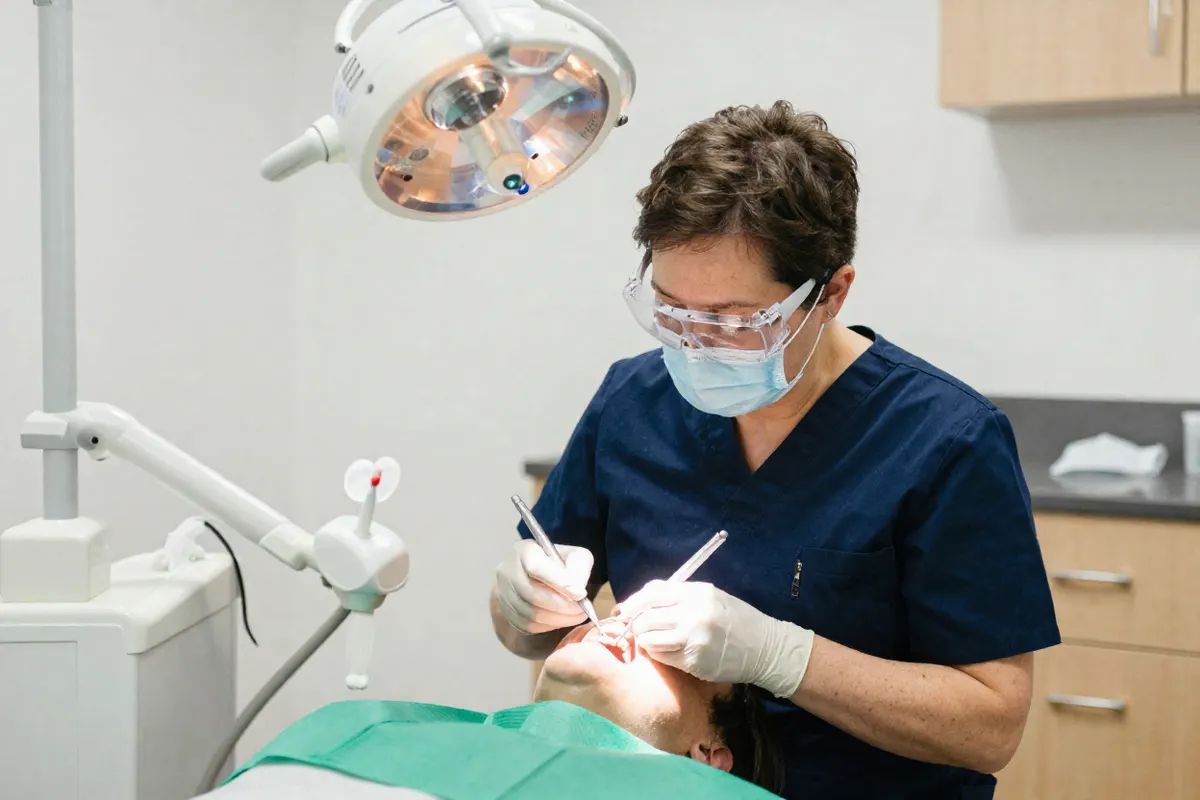
The dental team: dentists diagnose and treat, hygienists clean and prevent, assistants work chairside.
What the job is
Dental work is done by a small team in a dental office. The dentist diagnoses problems and does the treatment (fillings, crowns, root canals, extractions), the dental hygienist cleans teeth, checks gum health, takes x-rays and teaches prevention, and the dental assistant works beside the dentist during procedures and keeps instruments sterile and rooms ready. Dentists and hygienists need a state license; many dental assistants can start with on-the-job training, though most states require a credential for x-rays or expanded duties.
A typical shift
- Seat patients, review their medical history and take blood pressure before treatment
- Clean teeth, measure gum pockets and take x-rays (hygienists), or assist chairside and pass instruments (assistants)
- Diagnose decay and gum disease, plan treatment and do fillings, crowns and extractions (dentists)
- Disinfect treatment rooms and sterilize instruments between every patient
- Teach patients how to brush, floss and protect their teeth, and explain what treatment they need
- Chart findings, procedures and next visits in the practice software
What a shift looks like
A hygiene recall visit
Your patient is in for her six-month cleaning. You update her medical history, measure the gum pockets around each tooth, take bitewing x-rays and remove tartar, then show her where her gums bled. When the dentist comes in for the exam, you point out a cracked filling you spotted on the x-ray.
Assisting a crown preparation
As the dental assistant, you set up the room, place the topical anesthetic and hand the dentist instruments in order while keeping the tooth dry with suction. After the dentist shapes the tooth, you take a digital scan for the lab and make the patient's temporary crown.
An emergency toothache
The front desk squeezes in a patient with a swollen jaw. As the dentist, you take an x-ray, find an infected tooth and talk the patient through the options: a root canal to save it or an extraction. You start treatment that day and send a prescription and follow-up instructions home with him.
Who does well in this job
Dental work suits people who like precise, hands-on work and close focus for long stretches, and who are comfortable working in patients' mouths. Many dental assistants start straight from high school or from retail and food service jobs, many hygienists were assistants first, and many dentists came to it through a science degree. It rewards steady hands, good infection control habits and the ability to calm nervous patients. It also suits people who want predictable weekday hours with few nights or on-call shifts.
You will likely enjoy it if
- You like detailed, hands-on work with small instruments
- You want regular daytime hours more than the pace of a hospital
- You enjoy getting to know the same patients over years of visits
- You are comfortable with blood, saliva and close contact with patients
What you need
- Dental assistants: a high school diploma in most offices, plus the state credential your state requires for x-rays or expanded duties
- Dental hygienists: a degree from a CODA-accredited hygiene program, the national board exam, a clinical exam and a state license
- Dentists: a bachelor's degree, the Dental Admission Test, a DDS or DMD degree, written and clinical licensing exams, and a state license
- A current CPR or BLS card, a background check and up-to-date immunizations for most dental jobs
Skills that help
Your path into the job
- 1Pick a starting role: dental assistant to start within months, hygienist with about three years of school, or dentist with a bachelor's degree and dental school
- 2Look up your state dental board's rules so you know which credential each role needs where you live, especially for taking x-rays
- 3Choose a training route: an office that trains assistants, a CODA-accredited assisting or hygiene program, or pre-dental science courses and the DAT
- 4Finish training and pass the exams your role needs (DANB or state exams for assistants; the national board and a clinical exam for hygienists and dentists)
- 5Get your state credential or license and a current CPR or BLS card
- 6Apply to group practices, dental support organizations, private offices and community health centers, and expect a working interview
Common misconceptions
Myth: Dental hygienists are just assistants who clean teeth.
Reality: Hygienists hold their own state license after an accredited degree, a national board exam and a clinical exam. They assess gum disease, take and read x-rays, give local anesthetic and run their own patient schedule, while assistants work chairside with the dentist.
Myth: You need a degree to work in a dental office.
Reality: Many states let entry-level dental assistants learn on the job, and front desk roles need no clinical training. You will usually need a state credential before you take x-rays or do expanded duties, but you can often earn it while you work.
Myth: Dentistry is easy on the body because there are no night shifts.
Reality: The hours are regular, but the work is physically demanding: long periods bent over patients with a precise grip. Neck, back and shoulder pain are common in dental workers, which is why good posture, loupes and ergonomic habits matter from the first year.
What it pays
Open dental jobs that post a rate typically pay $20–$60/hr today, with a live median of $30 an hour across the 3,803 open jobs that state one.
The complete guide
Everything about dental jobs
Written by CareJobs.Now
CareJobs.Now reads every job and the pay it states from the employer's own job board each night, and takes a job down once its employer does.
How to become a dental assistant, dental hygienist or dentist in 2026: the work, the training, the exams and the first job
In 2025 the United States had about 388,600 dental assistant jobs - BLS, 225,300 dental hygienist jobs - BLS and 161,400 dentist jobs - BLS. Together they make up one of the few corners of healthcare where almost everyone works in the same kind of place: a dental office with weekday hours, a handful of treatment rooms and a team small enough that everyone knows each other's patients.
That shared setting hides three very different careers. A dental assistant can start with a high school diploma and on-the-job training in many states. A hygienist needs an accredited degree, a national board exam, a clinical exam and a state license. A dentist needs a bachelor's degree, four years of dental school and a license that can take years and hundreds of thousands of dollars to reach. People often move up the ladder between them, but each rung is its own decision.
This guide is for anyone deciding whether to work in dentistry, choosing between the three roles, picking a program, or trying to land a first job. It covers what each job really is, what a day in a dental office looks like hour by hour, the training routes and what they cost, the exams and state licenses, what employers screen for, the career ladder, and the hard parts nobody puts in the brochure. If you mainly want pay figures by state and setting, the companion guide on dental jobs and pay covers that in depth.
Contents
- Three jobs in one office
- A day in a dental office, hour by hour
- Training paths for each role
- Exams, licenses and state rules
- Getting your first dental job
- The career ladder and what each step takes
- The hard parts and how people handle them
- Outlook and how to decide
1. Three jobs in one office
A dental office runs on a division of labor that patients rarely see. The dentist diagnoses problems, plans treatment and does the procedures that change teeth: fillings, crowns, root canals, extractions, implants. The hygienist cleans teeth, measures gum health, takes x-rays, teaches prevention and screens for problems the dentist then confirms. The dental assistant works chairside with the dentist, prepares and sterilizes instruments, takes x-rays where the state allows, and keeps the operatory running between patients.
The lines between these jobs are drawn by state law, not by habit. Every state requires dentists and hygienists to be licensed, while states typically do not require licenses for entry-level dental assistants - BLS. That is why the training, the pay and the daily work differ so sharply, and why what a dental assistant may do in California differs from what one may do in Texas.
| Role | Typical training | Exams | Credential | Core work |
|---|---|---|---|---|
| Dental assistant | On-the-job training, or a certificate program of about 1 year | Varies by state; DANB exams are widely used | Often none at entry; a state credential for x-rays or expanded duties in many states | Chairside assisting, sterilization, x-rays, impressions, patient prep |
| Dental hygienist | Associate degree in dental hygiene (bachelor's optional) | National board exam plus a clinical exam | State license in every state | Cleanings, gum assessment, x-rays, sealants, local anesthesia, prevention teaching |
| Dentist | Bachelor's degree plus a DDS or DMD | Written national exam plus a clinical assessment | State license in every state; a specialty license for specialists | Diagnosis, treatment planning, restorations, extractions, surgery |
| Dental front desk | On-the-job training | None | Usually none | Scheduling, insurance, billing, patient check-in |
Program lengths and licensing rules: BLS dental assistants, BLS dental hygienists, BLS dentists.
The front desk row matters because many people start there. Dental receptionists, schedulers and insurance coordinators learn how a practice works without clinical training, and some move chairside later. That side of healthcare work is covered in our guide to front desk, scheduling and coding jobs.
How dental assisting differs from medical assisting
Dental assisting is often compared with medical assisting, because both are entry-level clinical jobs that can start with a short program. The difference is the patient and the pace. A medical assistant rooms many patients a day for a physician or nurse practitioner, takes vitals, gives injections and handles the inbox. A dental assistant spends long stretches at one chair, passing instruments, suctioning, mixing materials and anticipating the dentist's next move during a procedure. If you are weighing the two, our guide on becoming a medical assistant covers the clinic side.
How the pay compares
The pay gap between the three dental roles is wider than between most healthcare jobs that work side by side. The chart shows May 2025 national medians.
Sources: dental assistant median $48,070 - BLS, hygienist median $98,100 - BLS, and dentist medians by specialty - BLS. Each step up the ladder roughly doubles the median, and each step costs more time and money to reach. The rest of this guide is about what those steps actually involve.
2. A day in a dental office, hour by hour
Most dental offices run on a tight, predictable schedule, which is one of the job's real attractions. The example below follows a hygienist and a dental assistant through a plausible day in a busy general practice with two dentists. It is a composite, not one real person's day.
7:15 a.m. Setup. The assistant arrives first, turns on the equipment, runs the waterline and sterilizer checks, and sets up the first operatory for a crown preparation. The hygienist reviews the day's schedule: eight patients, two of them overdue for full-mouth x-rays, one with a heart condition that needs a medical history check before treatment.
7:45 a.m. Morning huddle. The team spends ten minutes going through the day: who needs treatment the dentist has already diagnosed, which patients are anxious, where there may be openings for an emergency. The front desk flags insurance issues. Huddles are short, but they are where a good office avoids surprises.
8:00 a.m. First patients. In the hygiene room, the hygienist updates the patient's medical history, takes blood pressure, and measures the depth of the gum pockets around each tooth, calling out numbers that the software records. She takes bitewing x-rays, removes plaque and tartar with ultrasonic and hand instruments, polishes, and talks the patient through brushing and flossing where she saw bleeding. Next door, the assistant seats the crown patient, places the topical anesthetic, and hands the dentist instruments in order while keeping the field dry with suction.
9:30 a.m. The dentist's exam. Near the end of each hygiene visit, the dentist comes in for a short exam. The hygienist presents what she found: a cracked filling on a molar, a new spot on an x-ray. The dentist confirms the diagnosis and the patient is scheduled for treatment. The hygienist's notes and x-rays are what make that two-minute exam work.
11:00 a.m. Turnover and sterilization. Between patients, the assistant breaks down the operatory, disinfects every surface, bags the used instruments and runs them through the sterilizer. Infection control is not a side task in dentistry: it takes up a real share of an assistant's day, and an office's reputation depends on it.
12:00 p.m. Lunch. Dental offices often close for lunch, which means a real break if the morning ran on time and a short one if it did not.
1:00 p.m. Afternoon procedures. The afternoon brings fillings, a child's sealants, an emergency toothache that the front desk squeezed in. The assistant takes a digital scan for the crown patient's permanent crown and makes the temporary. The hygienist sees a patient with gum disease for a deep cleaning, which includes giving local anesthetic.
4:30 p.m. Wrap-up. The hygienist finishes her charting and checks that the next recall visit is booked for each patient. The assistant restocks rooms and runs the last sterilizer load. Most dental assistants work full time, and some work evenings or weekends - BLS, so in many offices one evening a week and an occasional Saturday are part of the rotation.
How the day changes by setting
The rhythm shifts with the setting. In a pediatric office the pace is faster and more of the job is calming children and parents. In an orthodontic office, assistants help with wires and brackets all day, often for several patients at once, within what the state allows. In oral surgery, assistants work with sedated patients in a more surgical environment. In a community health center, many patients have not seen a dentist in years, so more visits are about pain, extractions and catching up on basic care. In 2025, health centers served about 6.97 million dental patients - HRSA.
3. Training paths for each role
The three dental roles have three very different training paths, and the right one depends on how much time and money you can invest before you start earning. The table summarizes them; the sections below explain how to choose within each.
| Role | Shortest route | Typical route | Rough cost of schooling |
|---|---|---|---|
| Dental assistant | On-the-job training (in states that allow it) | A certificate program of about 1 year - BLS | Varies widely by school |
| Dental hygienist | Associate degree | An associate degree program, usually about 3 years - BLS | Average in-state tuition and fees of $22,692 for an associate degree - ADEA |
| Dentist | Bachelor's degree, then dental school | A DDS or DMD program, typically four years, as at the University of Oklahoma | First-year cost of $46,845 for residents at public schools and $90,090 at private schools - ADA Health Policy Institute |
Becoming a dental assistant
Some states have no formal education requirement for dental assistants, and workers learn on the job, while others require graduation from an accredited program and an exam - BLS. Many programs take about a year and lead to a certificate or diploma; two-year associate programs are less common. The fastest route, where your state allows it, is to get hired as an entry-level assistant in an office that trains you, then add credentials as you go.
A formal program is still worth considering. It teaches radiography, infection control and chairside skills in a structured way, it usually includes clinical rotations in real offices (often the source of a first job), and graduation from a program accredited by the Commission on Dental Accreditation (CODA) is the most direct route to national certification. When you compare programs, ask whether the program is CODA-accredited, whether it includes the radiography course your state requires, what its graduates' exam pass rate is, and where students do their clinical rotations.
Becoming a dental hygienist
Hygiene school takes longer than many people expect. Most programs require college-level prerequisites, and the typical program takes about three years at a community college, technical school or university - BLS. As of June 2025 there were 346 accredited dental hygiene programs in the US - ADA News. Accreditation is not optional: in most states, a license requires a degree from an accredited program plus written and clinical exams - BLS.
Cost varies with the school. The ADEA reports average in-state tuition and fees of $22,692 for an associate degree and $36,382 for a bachelor's - ADEA, and those figures exclude instruments, books, loupes and board exam fees, which add up. Community college programs often cost less than four-year schools. A bachelor's or master's degree is usually needed only for teaching, research or some public health roles - BLS, so most clinical hygienists start with an associate degree.
When you choose a hygiene program, the questions that matter most are its first-time pass rates on the national board and the clinical exam, how many students finish on time, and how many patients students see in the program's clinic. Programs publish these numbers. The University of Pittsburgh, for example, reports an 88% first-time pass rate on the national board for its class of 2025 - University of Pittsburgh School of Dental Medicine. If a program will not tell you its pass rates, treat that as an answer.
Becoming a dentist
Most dental schools require at least a bachelor's degree and certain science courses - BLS, and nearly all require the Dental Admission Test. The DAT has four parts (natural sciences, perceptual ability, reading comprehension and quantitative reasoning) and is offered year round at Prometric test centers - ADA. Admission is selective: for the fall 2024 entering class, 6,719 students enrolled out of 12,491 applicants, across 79 accredited dental schools - ADA Health Policy Institute.
Dental school itself typically takes four years: at the University of Oklahoma, for example, the four-year curriculum begins with biomedical and dental sciences and moves into supervised patient care - OU College of Dentistry. It is expensive. The average indebted graduate in the class of 2025 owed $297,800 - ADEA. General dentists need no further training after dental school, but specialists complete a residency, usually 2 to 4 years, and oral and maxillofacial surgery typically takes 4 to 6 years - BLS.
Employer-paid and earn-while-you-learn routes
Because hygienists and assistants are hard to hire, some employers help pay for training. The most common form is simple: an office hires an untrained assistant and pays for the radiography or expanded-function courses the state requires. Some employers also offer tuition help toward hygiene school for assistants who commit to staying. For dentists, the biggest offsets to cost are service-based scholarships and loan repayment programs, so ask each school's financial aid office which ones its graduates use. Ask any employer you are considering what education support it offers, and get the terms in writing.
4. Exams, licenses and state rules
Licensing is where dentistry is most complicated, because each role has its own exam system and each state sets its own rules on top. This section walks through each role, then the state differences.
Dental assistants: DANB and state credentials
The best-known national credential for dental assistants is the Certified Dental Assistant (CDA) from the Dental Assisting National Board. It combines three component exams: Radiation Health and Safety (RHS), Infection Control (ICE) and General Chairside Assisting (GC) - DANB. To sit for the full CDA, you need to graduate from a CODA-accredited dental assisting or dental hygiene program, or have at least 3,500 hours of approved work experience plus a high school diploma, along with current hands-on CPR, BLS or ACLS - DANB. The combined exam has 245 questions and a test time of 195 minutes.
States then layer their own requirements on top, usually around x-rays and expanded duties. States that allow expanded duties such as coronal polishing require licensure, registration or certification, which means passing an exam and holding current CPR - BLS. Two large states show the range:
| State | What the rules say | Source |
|---|---|---|
| California | The Registered Dental Assistant credential requires one of several pathways (an approved program, at least 15 months and 1,280 hours of work experience, the DANB CDA, or others), board-approved courses including 32 hours of radiation safety, 12 hours of coronal polishing, 16 hours of pit and fissure sealants and 8 hours of infection control, plus a combined written and law and ethics exam | Dental Board of California |
| Texas | A dental assistant may not position or expose dental x-rays without a radiology certificate from the state board; applicants need a hands-on BLS course and either a board-approved course and exam or DANB certification plus a jurisprudence exam | 22 Tex. Admin. Code 114.2 |
The takeaway is practical. Before you choose a program or accept a job, look up your state dental board's rules for dental assistants, especially for radiography. A credential that is optional in one state can be the legal minimum for taking an x-ray in the next, and moving states can mean taking a new course.
Dental hygienists: the national board and a clinical exam
Every state requires hygienists to be licensed, and in most states that takes a degree from an accredited program plus written and clinical exams - BLS. In practice the pieces are graduation from a CODA-accredited program, the National Board Dental Hygiene Examination, and a regional clinical exam such as the one from CDCA-WREB-CITA, which is how the University of Pittsburgh describes the path for its graduates - University of Pittsburgh School of Dental Medicine. Each state board decides which clinical exams it accepts and may add its own law exam or other requirements.
The national board is a long exam. It has 350 multiple-choice items, 200 discipline-based and 150 built around patient cases, with seven hours and 30 minutes of testing time - JCNDE. The 2026 fee is $600. Candidates who fail must wait at least 60 days before retesting, and must pass within five years of their first attempt or five attempts, whichever comes first - JCNDE. Plan to test soon after graduating, while your coursework is fresh.
What a hygienist may do once licensed also depends on the state. As of August 2025, all states permit dental hygienists to administer local anesthesia, and 35 states allow hygienists to administer nitrous oxide - ADHA. Restorative duties, supervision rules and whether a hygienist can see patients without a dentist present all vary, and they shape both the jobs available and how interesting the work is.
Dentists: the INBDE and a clinical assessment
Dentists take the Integrated National Board Dental Examination, a written exam given over two days with about 12 and a half hours of total administration time; the 2026 fee is $890 - JCNDE. Most states also require a state or regional clinical exam - BLS.
The clinical requirement is where states differ most. Depending on the state, it can be met by a one-year postgraduate residency (PGY-1), a structured clinical exam, California's portfolio exam, or a hands-on exam from CDCA-WREB-CITA, CRDTS or SRTA; Delaware runs its own patient exam, and New York requires an approved PGY- 1 residency - ADA. If you know where you want to practice, check that state's accepted pathways early in dental school, because they decide which exam you sit for.
Moving between states
A dental or hygiene license is issued by one state. The Dentist and Dental Hygienist Compact is designed to let a licensee in good standing practice in other member states through a privilege to practice. Oklahoma became the 13th state to enact it in May 2026, but as of June 2026 the compact's commission had not announced when it will begin issuing privileges - Dentaltown. Until it does, moving to a new state means applying for a license there, and you should budget time for it.
5. Getting your first dental job
The good news is that dental offices are hiring. In the ADA's April 2026 analysis, only 60% of dentists said they had an adequate number of hygienists, and 91% of those recruiting a hygienist said it was very or extremely challenging - ADA Health Policy Institute. Right now there are 9,852 open dental jobs on this board, including 1,918 that mention a hygienist and 4,027 that mention a dental assistant.
Employers screen new dental hires on a short list, and most of it you can control before you apply.
- The legal credential: your license, or the state credential an assistant needs for x-rays.
- A current CPR or BLS card: many dental jobs require CPR certification - BLS.
- Infection control habits: managers watch how you handle instruments and surfaces.
- Software and equipment: the practice management software, digital x-ray and scanners you have used.
- Reliability: one missing assistant or hygienist can cancel a whole day of patients.
The credential and CPR items are gatekeepers: without them, an office cannot legally or safely put you in the chair. The rest are where you stand out. Reliability is what dental managers talk about most, because a small office has no one to cover for you, and a hygiene schedule that falls apart costs the practice a day's revenue.
The working interview
Dentistry has a hiring step most healthcare jobs do not: the working interview. An office invites you to work a half day or a full day alongside the team, so they can see your chairside skills and you can see how the office runs. Treat it as a two-way test. Watch whether the dentist is calm with the team, whether instruments are sterilized properly, and whether the schedule is realistic. Ask before you agree to it whether the working interview is paid.
Before you start, expect a background check and an immunization review. Under the OSHA bloodborne pathogens standard, employers must make the hepatitis B vaccine series available at no cost to employees with occupational exposure, and must provide bloodborne pathogens training at least annually - OSHA.
Where new dental workers get hired
For assistants, the most common first employer is the office where you did your clinical rotation or the office willing to train you. For new hygienists, large group practices and dental support organizations hire in volume and often take new graduates, while busy private practices may prefer someone with a year or two of experience but will hire a strong new graduate. As of 2025, 17% of dentists were affiliated with a dental support organization - ADA Health Policy Institute, and those groups hire hygienists and assistants as well as dentists.
Some new hygienists start by temping: filling in for hygienists who are out, often at several offices in the same month. It is a fast way to see how different practices run and to find the one you want to join, but it comes with no guaranteed hours and usually no benefits, and a new graduate can find it hard to work in unfamiliar offices without a mentor. If you go that route, our guide to per diem and PRN jobs explains how to weigh the higher rate against the missing benefits.
On this board you can browse dental employers on the employers page, including Aspen Dental, 42 North Dental and Willamette Dental Group, and community health centers such as Asian Health Services, which runs dental clinics in Oakland. If you are considering a hospital or health system dental clinic, our guide to how hospital hiring works explains the application system and interview steps.
Resume and interview points that work in dentistry
A dental resume should be short and specific. Put your license or credential at the top, with your state and number, and your CPR card. For new hygienists, list the number of patients you treated in school clinic and the procedures you did (scaling and root planing, local anesthesia, sealants). For assistants, list the procedures you have assisted, the x-ray systems and scanners you have used, and any expanded functions you are certified to do. A second language belongs near the top.
Expect interview questions about handling an anxious patient, a patient who refuses x-rays, a dentist running behind, and an infection control lapse you noticed. Ask your own: how long hygiene appointments are, how many patients a day, whether you will have an assistant or work alone, what the Saturday rotation looks like, and what continuing education money the office provides. Our healthcare job interview guide covers the common questions in more depth.
6. The career ladder and what each step takes
Dentistry has one of the clearest ladders in healthcare, and many people climb more than one rung. An assistant who loves the chair becomes a hygienist; a hygienist who loves diagnosis goes to dental school; a dentist who loves one kind of procedure specializes. Others move sideways into office management, teaching or public health.
Each step takes something different. Expanded-function assisting takes a state course and exam and adds duties such as coronal polishing or, in some states, sealants, which makes you more valuable to an office. Office management rewards organization and people skills more than clinical skill. The jump from assistant to hygienist is the biggest pay change on the ladder, and it takes an accredited degree program; years of chairside work make you a stronger applicant and a calmer student.
The hygienist to dentist step is rarer, because it means a bachelor's degree, the DAT and four years of dental school. Specialization adds a residency of 2 to 4 years, and ownership means buying or starting a practice. As of 2023, 72.5% of dentists were private practice owners, down from 84.7% in 2005 - ADA Health Policy Institute, so more dentists now spend part or all of their careers as associates or employees.
7. The hard parts and how people handle them
Dentistry is often described as a lifestyle job: weekday hours, no night shifts, little on-call. That reputation is mostly fair, but it leaves out the physical toll, the exposure risks, the pressure of a production schedule and, for dentists, the debt.
The physical toll comes first. Dental work means hours bent over a patient's mouth, holding small instruments with a precise grip. A 2022 meta-analysis of 88 publications found a pooled lifetime prevalence of musculoskeletal disorders of 78.4% among dental healthcare workers, with the neck, back and shoulders most often affected - F1000Research.
How people handle it: adjust the chair and patient so you work with a straight back, use magnifying loupes that let you sit upright, alternate instruments and grips, take micro-breaks between patients, and build strength outside work. Hygienists who stay in the field for decades usually invest in ergonomics early. It is far easier to set good habits in your first year than to undo pain in your tenth.
Infection and radiation
Dental workers are exposed to blood, saliva and aerosols every day. Hygienists and assistants wear safety glasses, masks and gloves to protect themselves and patients, and follow procedures to protect against radiation when taking x-rays - BLS. The OSHA bloodborne pathogens standard requires employers to offer the hepatitis B vaccine series at no cost and to train exposed employees at least annually - OSHA. The habits that protect you are simple and non-negotiable: never recap a needle by hand, handle sharps carefully, report any exposure immediately, and follow the office's x-ray safety procedures every time.
Production pressure and the schedule
Dental offices are small businesses, and the schedule is the business. Hygienists can feel squeezed when appointments are short and each visit is expected to include x-rays, a full cleaning, charting and a conversation about treatment. Assistants feel it when two dentists need them at once. The ADA reports that general dentist owners have faced practice expenses rising faster than revenue - ADA News, and that squeeze reaches the whole team through schedules and raises.
The people who handle this best choose their office carefully. Ask about appointment lengths before you accept a hygiene job, ask how many assistants support each dentist, and pay attention during the working interview to whether the team seems rushed or steady. If an office's schedule is unrealistic, the shortage of hygienists means you usually have other options.
Debt and isolation for dentists
For dentists, the hardest part is often financial. Average educational debt of $297,800 for indebted 2025 graduates - ADEA shapes where new dentists can afford to work and how soon they can buy a practice. Dentists in small offices can also feel isolated: they make clinical decisions alone, often run the business too, and have few peers on site. Study clubs, mentors and group practices help, and many new dentists deliberately start in a group setting to learn from colleagues before deciding whether to own.
8. Outlook and how to decide
The outlook is solid for all three roles. The BLS projects hygienist jobs to grow 8% from 2025 to 2035, with about 15,000 openings a year - BLS, dental assistant jobs to grow 7%, with about 53,000 openings a year - BLS, and dentist jobs to grow 6%, with about 4,800 openings a year - BLS. Hygiene programs graduated a record number of students in 2025 - ADA Health Policy Institute, which may ease the shortage over time, but most of the openings in every role come from people retiring or moving on, which keeps hiring steady. For a wider view across healthcare, see our guide to the fastest-growing healthcare jobs.
A decision framework
Dentistry is probably a good fit if most of these are true:
- You like precise, hands-on work: small instruments, steady hands, close focus.
- You want predictable hours: weekdays, few nights, little on-call.
- You like long relationships: seeing the same patients every six months for years.
- You can live with a physical job: and are willing to protect your body from day one.
Then choose the role by how much time and money you can invest. If you want to start earning within months, dental assisting is the door, and it lets you test whether you like dentistry before you commit to more school. If you can invest about three years and want a strong income without the debt of dental school, hygiene is the sweet spot. If you want to diagnose, treat and possibly own a business, and you can carry the cost, dental school is the path. If you dislike close contact with mouths, blood and saliva, consider the front desk side of a dental office or another field.
How to start this month
Look up your state dental board's rules for dental assistants and hygienists, so you know exactly what credential each job requires where you live. If you are leaning toward assisting, call a few local offices and ask whether they train new assistants and pay for the radiography course. If you are leaning toward hygiene, list the CODA-accredited programs near you, check their prerequisites and pass rates, and register for any science classes you still need. If you are aiming for dental school, talk to a pre-health adviser about prerequisites and DAT timing. Then browse the dental jobs on this site to see who is hiring near you and what they pay; right now postings that state pay typically offer $20 to $60 an hour across all dental roles. You can also browse by location on our state pages.
Dentistry asks a lot of your hands, your back and your patience, and the higher rungs ask a lot of your time and money. In return it offers steady demand, regular hours, a close team and a ladder you can climb at your own pace.
This guide reflects dental training, licensing and state rules as of October 2026. Rules, fees and pay change: check the linked source before you rely on a figure.
Frequently asked questions
How long does it take to become a dental hygienist?
Most hygienists earn an associate degree in dental hygiene, and the program usually takes about 3 years at a community college, technical school or university (BLS). After graduating you pass the National Board Dental Hygiene Examination and a clinical exam, then apply for your state license.
Do dental assistants need to be certified?
It depends on the state. States typically do not require a license for entry-level dental assistants, but many require a credential for x-rays, and states that allow expanded duties such as coronal polishing require licensure, registration or certification (BLS). The national CDA from DANB combines exams in radiation safety, infection control and chairside assisting (DANB).
How hard is it to get into dental school?
It is selective. For the fall 2024 entering class, 6,719 students enrolled out of 12,491 applicants (ADA Health Policy Institute). Most schools want a bachelor's degree with science courses and a Dental Admission Test score, and the average indebted graduate in 2025 owed $297,800 (ADEA).
What does the hygiene board exam cost?
The National Board Dental Hygiene Examination fee is $600 in 2026, and the exam has 350 multiple-choice items (JCNDE). If you do not pass, you must wait at least 60 days to retest. The clinical exam and your state license have separate fees.
Is dental assisting a good step toward hygiene school?
It is a common one. You learn infection control, x-rays and chairside work while you earn, and you find out whether you like dentistry before investing in a degree. Hygienists earned a median of $98,100 in May 2025, about double the $48,070 median for assistants (BLS); the dental career guide and dental jobs and pay cover both.
Related kinds of job
Medical Assistants
Clinic team members who room patients, take vitals, give injections and keep the provider's day on track.
Patient Access, Coding & Medical Admin
The people who register, schedule, verify insurance, code and bill so care keeps moving and gets paid.
More Allied Health
The specialists who feed, monitor, interpret for, counsel and support patients beside the nurses and doctors.